Executive Summary
For much of the last decade, enterprises have invested heavily in automation, analytics, cloud platforms, and intelligent systems. The results have been real but uneven. Productivity has improved in pockets, selected workflows have accelerated, and individual functions have modernized. Yet the operating model beneath those investments has often stayed the same. The tools changed. The logic of how the enterprise executes did not.
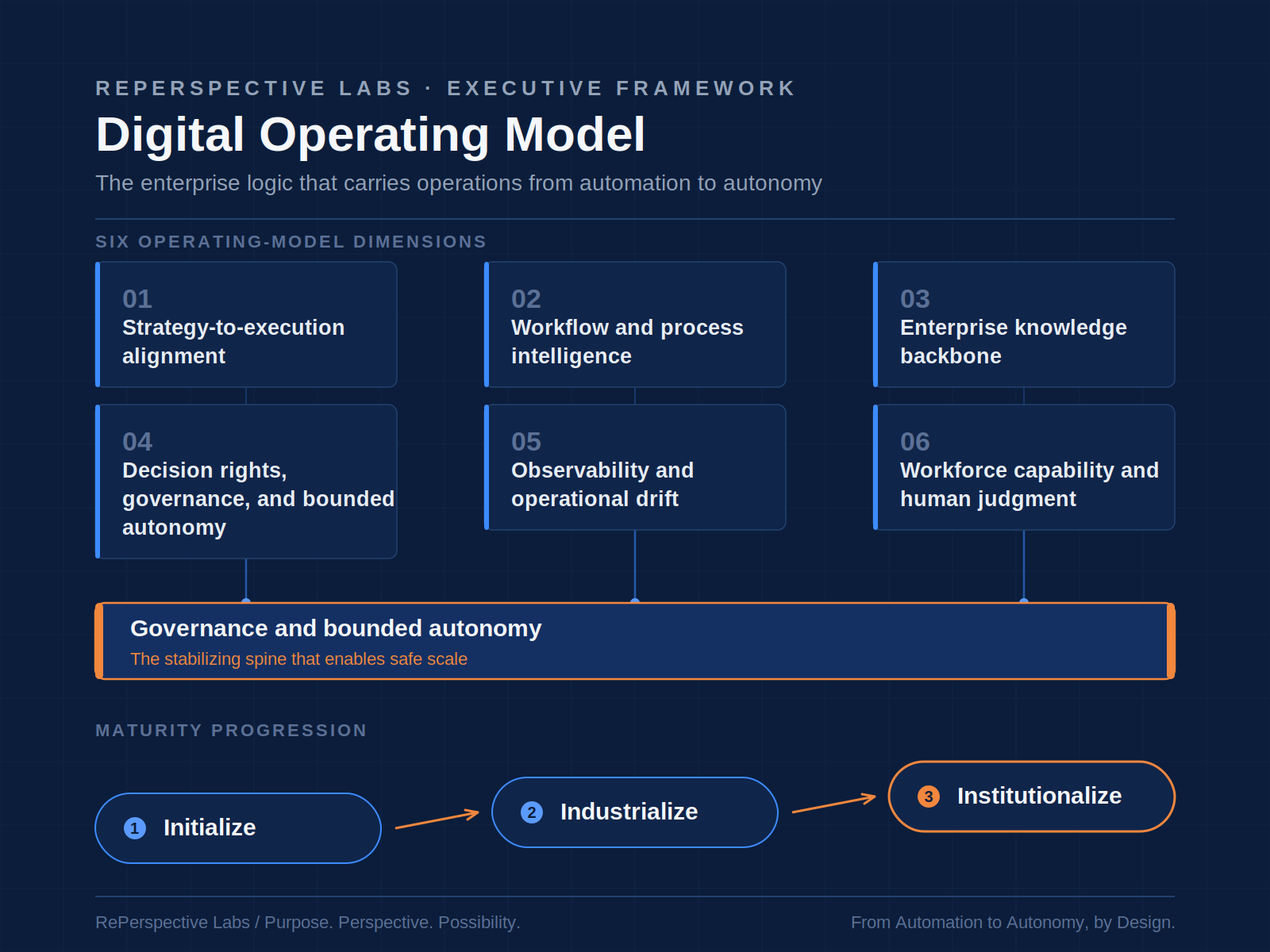
A Digital Operating Model is the layer most of those programs leave untouched. It defines how the organization actually creates value: how strategy becomes work, how workflows are designed, how knowledge is captured and trusted, how decisions are made and governed, how automation and AI participate in execution, and where human judgment must remain. It is the bridge between strategic intent and dependable execution, and it is what allows an enterprise to move deliberately from automation to autonomy.
This framework helps leaders assess and redesign the six dimensions of a Digital Operating Model. It treats AI and automation not as the destination but as enablers of a broader shift, from fragmented automation toward adaptive, governed, human-centered autonomy.
The Problem Beneath the Trend
Most organizations still treat AI adoption as a technology question. They evaluate platforms, run pilots, select use cases, and stand up governance groups or centers of excellence. The activity is genuine and the intent is serious. But the progress is usually narrower than the investment would predict.
The deeper issue is that intelligent systems are being added to operating models designed for a different era. Those models assume that work is largely sequential. Decisions move through fixed hierarchies. Knowledge lives in documents, shared drives, personal experience, and institutional memory. Governance happens through periodic review. Accountability is attached to roles and functions, even when the work itself crosses boundaries.
When intelligent systems are layered onto that foundation, the outcome is predictable. Workflows accelerate in some places and stall in others. Knowledge stays fragmented. Decision rights remain ambiguous. Governance becomes reactive. Adoption varies widely by function. Leaders see motion, but not enterprise-level compounding value. This is not only a model-selection problem and not only a platform problem. It is an operating model problem, and it is the reason the maturity of the operating model matters more than the choice of any single model or tool.
What Is Changing
Three shifts are making operating model redesign unavoidable.
First, work itself is becoming hybrid.
Tasks are no longer performed only by people or only by systems. They are increasingly carried out by combinations of employees, platforms, automation, AI assistants, workflow engines, and intelligent components operating together. The operating model has to define how that collaboration is structured, supervised, improved, and governed.
Second, decisions are becoming more distributed.
Intelligence is moving closer to the point of work. Systems can surface context, recommend next actions, detect exceptions, and, within bounded limits, execute decisions directly. This changes the speed, the location, and the accountability of decision-making across the enterprise.
Third, knowledge has become operational infrastructure.
The performance of AI-enabled systems depends on the quality, structure, accessibility, and trustworthiness of enterprise knowledge. Policies, procedures, product information, process rules, exception logic, decision history, and institutional context are no longer passive documentation. They are active ingredients in execution, and they behave as a catalyst: the better the knowledge, the more useful intelligent systems become.
Each of these shifts has implications for roles, workflows, controls, data, platforms, leadership, and culture. Together they call for a different operating model, not a lightly upgraded version of the old one.
What a Digital Operating Model Actually Means
A Digital Operating Model is the deliberate design of how an enterprise creates value when intelligence, automation, and human judgment must work together at scale. It answers a practical set of questions.
How does strategy translate into the work that actually gets done? How are workflows designed so automation and AI improve execution instead of introducing fragility? Where does authoritative enterprise knowledge live, and how is it kept current? Which decisions can be delegated to systems, which require AI-assisted human judgment, and which must remain fully human? How is accountability preserved when work is increasingly performed by hybrid teams of people and intelligent systems? And how do people grow, contribute, lead, and exercise judgment when execution is shared with machines?
A Digital Operating Model is not a diagram, a platform, or a transformation slogan. It is the enterprise execution logic made explicit and coherent. It is the bridge between strategic intent and autonomous execution.
What This Looks Like in Practice
A useful way to think about the journey is in three stages, moving from initializing the model, to industrializing it, to institutionalizing it.
Initialize
In the initialize stage, the organization makes its current operating model visible. It maps how work actually flows, where decisions are really made, how knowledge moves, and where governance occurs today. It selects one or two high-value value streams and redesigns them end to end rather than launching a broad program that tries to change everything at once. The goal is evidence, not coverage.
Industrialize
In the industrialize stage, the redesigned value streams are stabilized and extended. Automation and AI are introduced into deliberate workflows rather than bolted onto legacy ones. Decision rights, risk tiers, and escalation paths are defined. Observability and evaluation are built in so that drift is detected and corrected, not discovered after it has caused harm. The knowledge backbone is strengthened so that intelligent systems draw on trusted, current information.
Institutionalize
In the institutionalize stage, the operating model becomes a living asset. Build, operate, and transform run as a continuous cycle rather than a one-time project. As systems mature, as the workforce learns, and as the enterprise moves through automation, orchestration, and bounded autonomy, the model is updated with discipline. The point is not to design once. It is to design with intent and to update with rigor.
The progression is rarely linear, and that is the point of treating it as a model rather than a checklist. A value stream may be fully industrialized while an adjacent one is still being mapped. A function may be ready for bounded autonomy in a narrow, well-governed task while remaining firmly human-led elsewhere. A Digital Operating Model gives leaders a common language for those differences, so that the pace of change in each part of the enterprise is a deliberate choice rather than an accident of where a pilot happened to land.
What Leaders Should Do Differently
Operating model reinvention is not a technology program. It is an enterprise design exercise, and it belongs with the leaders who set strategy, allocate capital, own outcomes, manage risk, and shape culture.
Governance should be designed before autonomy is extended, not afterward. Decision rights, risk tiers, escalation paths, monitoring, and accountability mechanisms belong in place before intelligent systems are allowed to act with meaningful agency. Governance is the spine that makes safe scale possible, and it is a design dimension from the first day, not a cleanup activity after deployment.
The operating model should be separated from the platform conversation. Platforms matter, but they are inputs. They do not define the model. A Digital Operating Model determines how platforms are used, where intelligence is applied, what work is redesigned, and how accountability is preserved. Technology choices should follow operating logic, not lead it.
Human judgment should be placed deliberately, not by default. The aim of hybrid execution is not to remove people from the work. It is to move human attention toward the decisions that require context, ethics, and accountability, while systems carry the routine throughput. This is the synergy that matters: AI handles speed and scale, and people hold the judgment that turns information into wisdom. Workforce capability, role redesign, and leadership preparation should advance in step with the introduction of intelligent systems into real workflows, so that people are ready for higher-judgment work rather than displaced by the change.
There is a discipline that ties these choices together. Probabilistic systems drift. Their behavior changes as data, context, and usage shift, and a model that performed well at launch can degrade quietly over time. A mature operating model assumes this and designs for it, with observability, evaluation, and clear release criteria built into how intelligent systems are run. Treating drift as a managed condition rather than a surprise is what separates programs that scale safely from those that stall after the first incident.
Practical Operating-Model Implications
Several implications follow for how leaders organize the work of redesign.
Operating model decisions should sit at the executive table, not only the technology table. Strategy, operations, risk, technology, finance, and human capital leaders all hold ownership in the model, because no single function can redesign execution alone.
Knowledge architecture deserves enterprise-level investment. Knowledge can no longer be treated as a byproduct of functional documentation. It is infrastructure for reliable execution, and it is the catalyst that determines how much value intelligent systems can create.
Measurement should focus on outcomes, not activity. A mature operating model is judged by the quality, reliability, adaptability, and resilience of execution, not by the number of automations deployed or pilots launched. Workforce planning should be tightly coupled to operating model design so that capability and execution evolve together.
Leadership Application Checklist
Seven diagnostic questions to assess where an organization stands on operating-model maturity.
- Have we made the current operating model visible: how work flows, where decisions are made, how knowledge moves, and where governance actually occurs?
- Have we chosen one or two high-value value streams to redesign end to end, rather than launching a broad program that changes everything at once?
- Is governance defined before autonomy is extended, with clear decision rights, risk tiers, and escalation paths?
- Do we have observability and evaluation in place so operational drift is detected and corrected, not discovered after harm?
- Is enterprise knowledge treated as infrastructure: structured, current, and trusted enough to support AI-enabled decisions?
- Does ownership of the operating model sit at the executive table, across strategy, operations, risk, technology, finance, and human capital?
- Are we measuring outcomes such as reliability, adaptability, and resilience, rather than counting automations deployed or pilots launched?
Bottom Line
The shift from automation to autonomy is not primarily a technology shift. It is an operating model shift. Adding AI to a legacy operating model produces faster execution of work that may itself need to be redesigned. Redesigning the operating model first, and then introducing automation and intelligence into a deliberate system of workflows, knowledge, decisions, governance, and people, is what creates durable advantage.
The leaders who recognize this early will spend the coming years redesigning enterprise logic rather than accumulating tools. The organizations that follow them will define what AI-era operations actually look like. A Digital Operating Model is the bridge. It connects strategy to autonomous execution, and human judgment to intelligent systems, in a way that is governed, adaptive, and built to last.
About This Framework
RePerspective Labs develops executive frameworks for AI-era operations, enterprise automation, and the shift from automation-led efficiency to autonomous, adaptive, human-centered operating models.
This framework helps leaders rethink the enterprise logic behind execution: how strategy becomes work, how workflows are redesigned, how knowledge becomes operational infrastructure, how governance enables bounded autonomy, and how human judgment remains central as intelligent systems scale.
From Automation to Autonomy, by Design.