 RePerspective Labs
INSIGHT
Deep Dive
From Workflows to Work Intelligence
Designing the context, decisions, and feedback that turn workflow execution into better enterprise outcomes.
Executive summary
Workflow completion tells leaders that work moved; it does not establish that the right decision was made. Work intelligence connects operational signals, trusted knowledge, decision authority, and outcomes so teams can resolve cases on a defensible basis and improve future work. Its value depends on the connections between those capabilities, especially at handoffs. Leaders should invest where missing context or inconsistent judgment constrains a meaningful outcome, while preserving reliable automation where rules suffice. The test is whether the operation achieves better results after accounting for review effort, maintenance, and risk.
The question
Where does a completed workflow leave the decision unresolved?
A workflow can move an invoice to the correct queue and still leave an analyst to reconstruct why it failed, which evidence applies, and who can resolve it. The routing is functioning. The decision remains expensive.
That distinction matters when leaders decide what to improve next. A faster transfer may simply deliver the same unresolved question to the next team sooner. A richer dashboard may expose the delay while leaving the people handling it without usable context. Neither result establishes whether the supplier was paid correctly, the customer’s problem was resolved, or the same issue will return.
The executive question is therefore specific: which decisions are constrained by missing context, and what must connect around them to improve the outcome? Answering it requires looking inside the work, including the explanations, workarounds, and judgments that rarely appear on the process map.
My perspective
I would treat work intelligence as a capability the business owns: the ability to bring reliable context into a consequential decision, act within clear authority, and learn from the result. The investment is justified where that connection improves the outcome. More AI, more data, or more autonomy is not sufficient evidence of progress.
Shashi Sethi
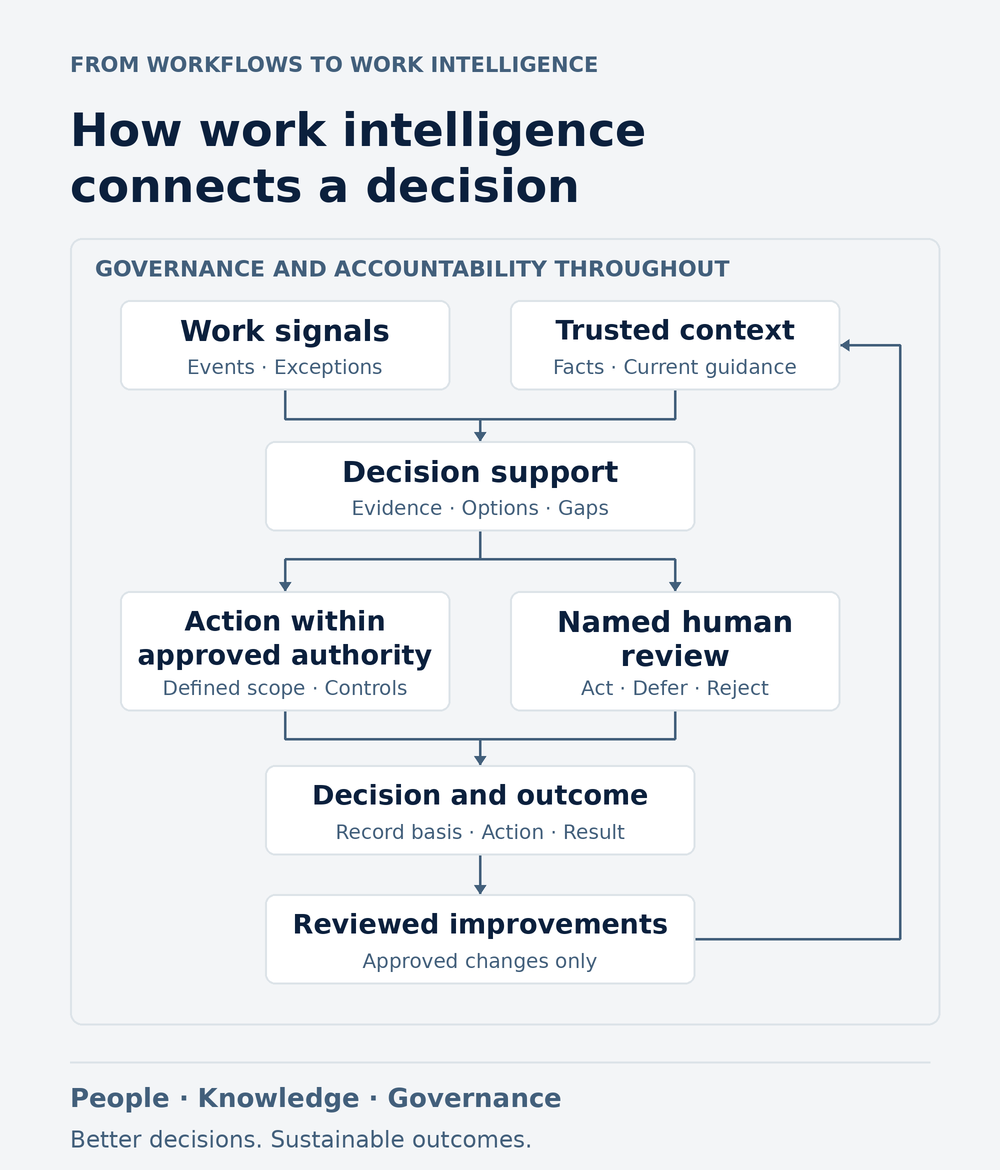
Signals and trusted context inform a decision; authority governs action; verified outcomes inform reviewed improvements.
The approach
Start with the decision that holds back the outcome
Work intelligence describes an operating capability here. It can draw on people, rules, analytics, knowledge systems, and AI. Its design begins with the outcome the operation exists to deliver.
For accounts payable, that might mean paying valid obligations correctly and on agreed terms, with manageable effort and reliable supplier relationships. “Review invoice” is too broad to reveal what prevents that outcome. The consequential decision might be whether a mismatch reflects a genuine commercial dispute, an incomplete record, or an error in how information was captured.
Those causes imply different investments. Missing facts require better capture. Conflicting guidance requires an accountable policy decision. A predictable validation failure may need a rule or integration fix. Ambiguous material may warrant assistance that assembles evidence for an experienced reviewer.
Begin by examining real cases with the people who handle them. Trace where they search, whom they consult, and which facts change their decision. Different answers are sometimes justified by different circumstances; inconsistency becomes a problem when comparable cases receive different treatment without a defensible reason.
This diagnosis protects the investment from solving the wrong constraint. It also establishes whether a simpler change could deliver the intended result.
Connect the intelligence layer around that decision
The Work Intelligence Stack brings together five elements. Their value depends on what passes between them.
| Element | What it must contribute to the decision |
|---|---|
| Work Signals | A specific event, exception, or change linked to the case and its operating history. A pattern indicates where to investigate; it does not establish a cause. |
| Context and Knowledge | Relevant case facts and applicable guidance, with source, version, and known gaps visible. Prior decisions must be distinguishable from approved policy. |
| Decision Logic | The available options, decision criteria, and authorized scope of action. Business purpose and authority must be set explicitly. |
| Orchestration and Action | The decision and its supporting context reach the person or system able to act, inside the working process. Unresolved questions travel with the handoff. |
| Governance and Learning | Evidence of what was decided, who or what acted under whose authority, and what happened afterward. Proposed changes return to accountable owners for review. |
These elements need not be separate platforms. Governance applies throughout them, and learning depends on the quality of the records they produce.
A useful design preserves the distinction between a recorded fact, a retrieved policy, a suggested explanation, and an authorized decision. When a case crosses a team or system boundary, those distinctions should survive. Otherwise, a tentative interpretation can become an accepted fact simply because the next team receives a polished summary.
NIST’s July 2024 Generative AI Profile identifies false but confident outputs as a risk, including fabricated logic or citations offered to explain an answer. A generated explanation therefore needs verification against the underlying evidence. NIST, Generative Artificial Intelligence Profile, section 2.2.
My design preference is to preserve the actual records and decision basis alongside any AI explanation. Missing evidence should remain visible, and a reviewer should be able to reopen the source without rebuilding the investigation.
A recurring invoice exception, redesigned
Hypothetical example — proposed operating design, not a reported implementation or achieved result.
An accounts-payable team repeatedly receives mismatches from one supplier. Its workflow captures invoices and routes exceptions correctly. Analysts inspect each invoice, consult procurement, and reconstruct the same explanation. In this scenario, the supplier has changed its document layout, and item identifiers are no longer captured consistently.
The operating objective is to resolve valid invoices accurately and prevent avoidable recurrence while preserving payment controls.
In the proposed design, an exception view groups the recurring mismatches and assembles the original invoices, purchase orders, extraction records, and approved matching guidance. An assistant could suggest a capture problem for investigation, with the supporting records attached. That suggestion remains a hypothesis until an analyst checks it against the documents.
The analyst confirms the layout change and refers the proposed correction to the owner responsible for document capture. Procurement resolves any uncertainty about the supplier’s item references. A designated owner of the process spanning finance and procurement coordinates the response so each team does not close its part while leaving the underlying issue unresolved.
The correction is tested and approved before release. Individual invoices continue through existing validation and payment authority; detecting a recurring problem does not authorize bypassing those controls. A previous exception approval also does not become a general rule automatically.
The potential benefit is less repeated investigation, fewer avoidable mismatches, and more reliable payment timing. To test that hypothesis, compare similar invoices before and after the change, accounting for volume and complexity. Check recurrence, resolution time, downstream corrections, and total analyst and support effort. A shorter queue alone would be weak evidence if errors had merely moved further into the process.
If a stable capture correction removes the problem, that may be the lasting solution. The intelligence capability has helped the enterprise identify and implement the right change; it need not remain involved in every future invoice.
Evaluate the human and system together
Evidence supports the potential for assistance inside real work, while showing why its value must be tested in context.
In Generative AI at Work, published in February 2025, Erik Brynjolfsson, Danielle Li, and Lindsey Raymond studied a staggered deployment involving 5,172 customer-support agents at one company. AI assistance increased issues resolved per hour by about 15% on average. Effects varied: less experienced and lower-skilled workers improved in speed and quality, while the most experienced and highest-skilled workers saw small speed gains and small quality declines. These are findings from a particular support operation, not a forecast for every workflow. Brynjolfsson, Li, and Raymond, Generative AI at Work, author manuscript.
A broader caution comes from Michelle Vaccaro, Abdullah Almaatouq, and Thomas Malone. Their October 2024 meta-analysis covered 106 experiments published between January 2020 and June 2023. Human–AI combinations improved on humans alone on average, but performed worse than the better of humans or AI alone. The study spans varied tasks and earlier AI systems; it does not benchmark today’s enterprise deployments. Vaccaro, Almaatouq, and Malone, When combinations of humans and AI are useful, author manuscript.
The leadership implication I draw is to evaluate the actual working arrangement. A model’s test score cannot establish whether an analyst with that model, under ordinary time pressure and with the available evidence, makes a better decision.
Compare the proposed arrangement with a credible baseline, including simpler process improvements. Examine results by case complexity and worker experience. Include incomplete and conflicting evidence, and test whether escalation reaches someone able to resolve it. Review a sample of decisions independently; agreement with the assistant is not proof of correctness.
People also need the conditions to contribute judgment. Give them access to source material, authority to challenge a recommendation, and time to record a useful correction. Reward sound decisions and justified escalation. An acceptance-rate target can encourage people to endorse suggestions that deserve scrutiny.
Fund what keeps the decision reliable
The intelligence layer creates continuing responsibilities. Someone must maintain the knowledge, resolve disputed definitions, test changes, monitor outcomes, and support the people using it. Those responsibilities require allocated capacity and operating funding.
Start within a bounded operation, but preserve the connections needed to see its outcome. A decision record should link the case, relevant source versions, applicable rule, selected action, and eventual result. Record material overrides and their reasons. Collect what is needed to improve the work, with clear access and use boundaries.
This record supports a more useful review than a count of completed tasks. Leaders can investigate whether a change improved resolution quality, reduced avoidable recurrence, or simply transferred effort to another team. They can also distinguish a sound decision that encountered an unfavorable outcome from a poor decision that happened to end well.
The operating case should include integration, knowledge maintenance, evaluation, review time, and support costs. Released time becomes useful capacity only when the organization can put it to work. If a rule change or upstream correction makes an AI step unnecessary, simplifying the process should count as success.
Within the Transformation Operating Map, this is primarily Phase 3: Build the Intelligence Layer. It depends on the work and authority choices of Phase 2 and supplies decision evidence for Phase 6. The enduring responsibility is to keep those connections usable as the operation changes.
Leadership takeaway
Can we explain one decision from evidence to outcome?
At your next operations review, choose one consequential decision and examine a small sample of recent cases: a routine case, an exception, and a decision that later needed correction.
Ask the team to show what was known at the time, which guidance applied, who had authority, what action followed, and how the result was assessed. Include the operator who handled the work and the owner accountable for its outcome.
Use the gaps to choose the next investment. It may be better information capture, clearer policy, a simpler workflow, or targeted AI assistance. Agree on the evidence that would justify keeping, changing, or stopping the intervention.
That review turns an abstract ambition for work intelligence into an operating decision the enterprise can own and test.
Sources and further reading
Evidence used in this article
- Erik Brynjolfsson, Danielle Li, and Lindsey Raymond — Generative AI at Work. Published online in The Quarterly Journal of Economics, February 4, 2025; May 2025 issue, 140(2), 889–942. Evidence from a staggered customer-support deployment; supports the discussion of context-dependent assistance and differences across workers. Journal record · Accessible author manuscript, revised November 6, 2024.
- Michelle Vaccaro, Abdullah Almaatouq, and Thomas Malone — When combinations of humans and AI are useful: A systematic review and meta-analysis. Nature Human Behaviour, published October 28, 2024. Synthesizes experiments published January 2020–June 2023; distinguishes improvement over humans alone from outperforming the better standalone participant. Journal record · Accessible author manuscript, revised October 29, 2024.
- National Institute of Standards and Technology — Artificial Intelligence Risk Management Framework: Generative Artificial Intelligence Profile, NIST AI 600-1. Released July 26, 2024. Section 2.2 supports the discussion of false outputs and fabricated explanations or citations. Used as risk guidance, not as evidence that the proposed operating design delivers business benefits. Publication record · Full profile.