 RePerspective Labs
INSIGHT
Founder's Perspective
Why AI Requires Operating Model Reinvention
AI can release capacity. Lasting enterprise value depends on redesigning the work, authority, and responsibilities needed to turn that capacity into better outcomes.
Executive summary
AI can improve individual tasks while leaving the business outcome constrained by the same queues, approvals, and fragmented responsibilities. Enterprise transformation requires leaders to examine how those dependencies fit together. The scope of reinvention should follow the outcome: a useful assistant may need modest changes, while a redesigned service may require new decision rights, knowledge ownership, staffing arrangements, and performance measures. The leadership task is to connect local gains to a complete, sustainable way of working. That means funding the surrounding changes, giving an outcome owner authority across the workflow, and testing whether customers and employees experience the intended improvement.
The question
What must change for better AI to produce a better operation?
An executive can reasonably ask why a useful AI assistant should trigger a discussion about the operating model. If it helps employees prepare information or complete a task more efficiently, why make the initiative larger?
The answer depends on the ambition. Helping an employee finish the same work with less effort is a legitimate outcome. Promising a faster service, a more dependable decision, or an operation that can handle greater demand introduces a different set of dependencies.
Information must reach someone who can use it. Decisions must be made at the right point. Review capacity must match the work arriving. Employees need a workable role in the new arrangement.
The question is how much of the operation must change for the intended result to become possible. That is the distinction leaders need to resolve before treating a successful AI task as evidence that the wider business has been transformed.
My perspective
My view is that operating model reinvention becomes necessary when the outcome we want depends on changing how work, authority, knowledge, and human capacity fit together. I would scope that redesign around a complete business outcome, then expand where evidence justifies it. Greater AI capability does not, by itself, justify greater autonomy.
Shashi Sethi
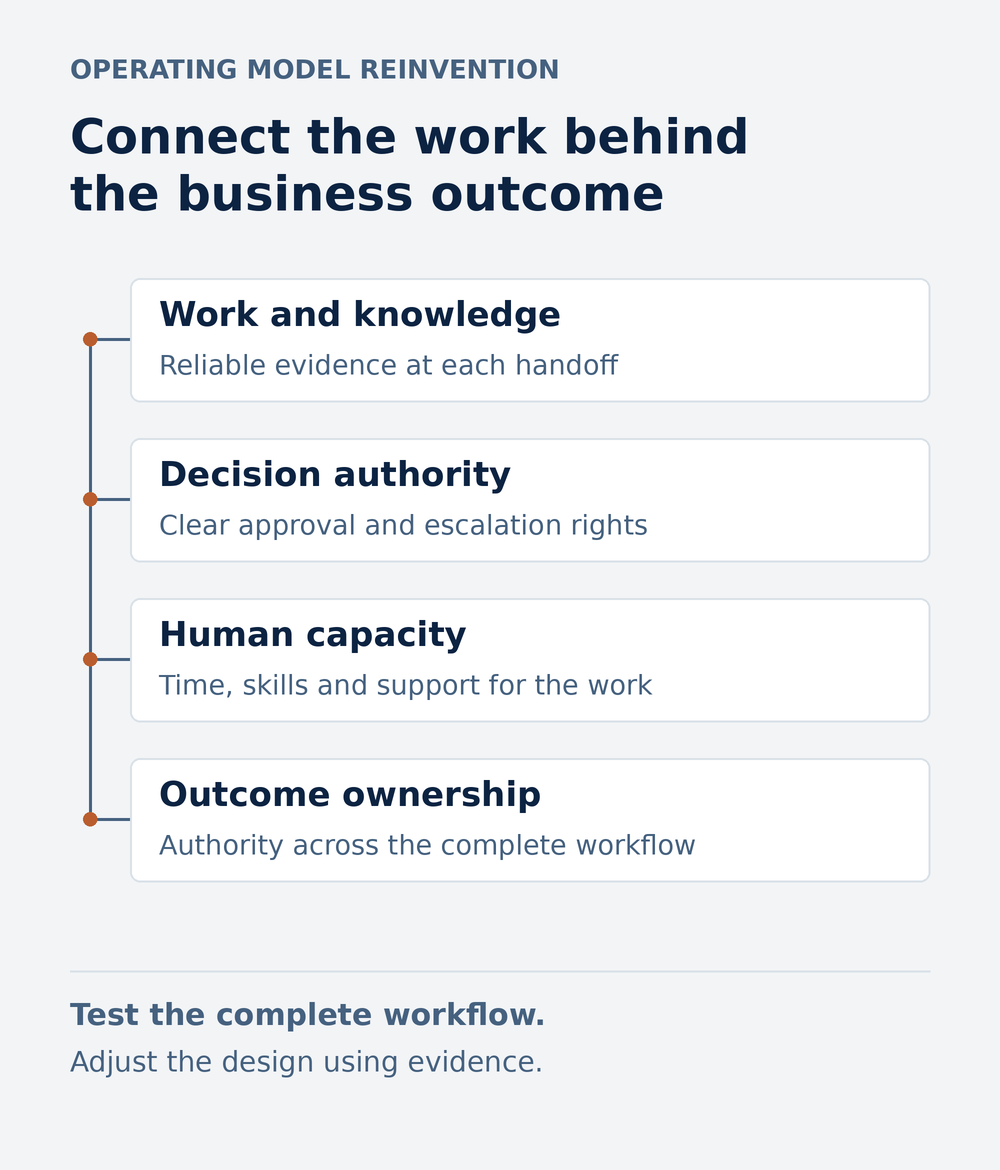
Connected work, knowledge, authority, people, and ownership support a complete business outcome. Test the workflow and adjust the design using evidence.
The approach
Local gains need a path to enterprise value
There is credible evidence that AI assistance can improve real work. In research published in 2025, Erik Brynjolfsson, Danielle Li, and Lindsey Raymond studied a staggered rollout involving 5,172 customer-support agents serving one company. Access to assistance increased issues resolved per hour by 15% on average, with substantially different effects across workers. The rollout occurred mainly in late 2020 and early 2021. This is evidence from a particular operating setting, not a universal savings forecast. Generative AI at Work, The Quarterly Journal of Economics.
The operating question is where a gain travels next. If preparation becomes faster but approval remains the constraint, the customer may still wait. If more cases reach a specialist without better context, review effort may increase. If time is released in scattered intervals that cannot be reassigned, useful relief may never become additional service capacity.
These are different outcomes and should be valued honestly. Reduced effort can improve employees’ working experience. Usable capacity may help absorb demand. Cash savings require an actual change in expenditure. Leaders should identify which benefit they intend to realize and what has to happen after the AI task for that benefit to appear.
That connection determines the appropriate scope of redesign.
AI changes the assumptions beneath the work
An operating model describes how an organization delivers its purpose: how work moves, how decisions are made, who carries responsibility, and how resources and controls support the result.
AI can alter the assumptions behind that arrangement. In the customer-support study, less experienced workers benefited more, while the most skilled workers saw small speed gains and small quality declines. That finding gives leaders a reason to test different roles and review arrangements instead of assuming one deployment pattern suits everyone. Generative AI at Work.
There is also a different uncertainty to manage when generative AI produces the information used in a decision. NIST’s 2024 Generative AI Profile identifies risks from false outputs presented confidently and from people placing excessive trust in AI. A fluent recommendation can therefore require a different kind of checking from a completed rules-based transaction. NIST Generative AI Profile, sections 2.2 and 2.7.
The design implication is to examine the relationships around the capability. If an employee is accountable for a decision, can they see the supporting evidence, challenge the recommendation, and obtain help in time? If the answer depends on a policy, who establishes which version applies and resolves conflicting guidance?
Those choices are connected. More delegation increases the importance of reliable context and effective intervention. Retaining review preserves a human decision point but consumes attention and can create a bottleneck. The operating model must make that trade-off workable at the expected volume.
An illustration: redesigning a claims decision
Hypothetical example — proposed design, not a reported engagement or measured result.
Consider an insurer seeking to reduce the time from receiving a complete claim to communicating a well-supported decision. It introduces an assistant that prepares a case summary and assembles relevant information for an adjuster.
In the initial design, the assistant produces a useful summary, but the adjuster still has to locate the applicable policy, resolve missing evidence, and join the same review queue. Measuring summary preparation alone would miss much of the work determining the claimant’s experience.
A broader design could change the following relationships:
| Operating element | AI added to the existing arrangement | Proposed redesign |
|---|---|---|
| Case preparation | The summary arrives separately from the evidence needed to decide. | The summary travels with source references, the applicable policy version, and clearly identified information gaps. |
| Decision and review | Every case follows the existing approval path, regardless of what the assistant has changed. | Authorized adjusters retain coverage and payment decisions. Review routes reflect case complexity, established authority, and unresolved evidence. |
| Exceptions and people | Employees absorb verification and correction work alongside their existing workload. | Review capacity, training, and specialist support are planned explicitly; employees can challenge outputs and escalate concerns. |
| Ownership and improvement | Each team measures its own activity; recurring corrections stay in individual case files. | A claims outcome owner coordinates the workflow, while named policy, quality, and technology owners resolve recurring problems. |
Illustrative design comparison. Any improvement would need to be demonstrated in the insurer’s own operating environment.
The proposed benefit is a shorter path to a sound decision with less avoidable rework. Test that proposition against the current baseline using complete-case turnaround time, decision quality, reopened cases, and total handling effort, including verification and exceptions. Keep case complexity comparable so a shift toward easier cases does not masquerade as improvement.
If preparation becomes faster while correction work or decision errors increase, the design needs revision. If knowledge cannot be made reliable enough, narrow the assistant’s role. The operating model creates conditions for success; the capability must still prove it can perform within them.
Give the outcome owner authority across the workflow
The claims illustration exposes a leadership issue: the team introducing AI may be unable to change the conditions that determine its value.
Operations controls staffing. A policy owner controls authoritative guidance. Risk and quality functions shape review requirements. Technology operates the capability. If each protects its own targets without a shared outcome, the necessary changes can remain unresolved between them.
I would give a named Outcome owner responsibility for the complete outcome, supported by explicit decisions about what that owner can change and what requires executive resolution. Specialists retain their responsibilities. The outcome owner needs a way to reconcile dependencies, secure resources, and escalate conflicting priorities.
Funding should cover those dependencies. Research on the productivity J-curve explains why general-purpose technologies depend on complementary investments, including changes to processes and human capability. It supports treating organizational work as a substantive part of technology investment; it does not establish a guaranteed return or timetable for an individual AI initiative. Brynjolfsson, Rock, and Syverson, The Productivity J-Curve, January 2021.
The workforce commitment also needs to be explicit. Removing routine work can leave a role concentrated on difficult cases. Leaders should determine how people will develop that capability, how workloads will change, and how released time will be used. If staffing changes are contemplated, communicate them honestly. A promise of more meaningful work needs an actual role, adequate support, and credible expectations behind it.
Match the redesign to the outcome
Reinvention can start with one defined service or workflow. It need not begin with a company-wide reorganization.
A low-risk internal drafting assistant may fit within existing responsibilities once appropriate use and review are established. A service that changes who decides, which approvals remain, or how work crosses departments requires broader operating design. The scope should include the dependencies capable of preventing the intended result.
Some constraints should remain. A necessary independent review is a design requirement. Leaders can improve the evidence reaching that reviewer or adjust capacity without eliminating the safeguard. Where the cost of reliable operation exceeds the expected benefit, keeping the capability in a narrower assistive role may be the better decision.
As the work changes, use performance evidence and employee feedback to revisit the arrangement. A recurring correction may call for better knowledge, a different routing rule, additional training, or less delegation. The response should follow the cause.
This is the design question within Phase 2, Design the Operating Model, of the Transformation Operating Map. The Digital Operating Model Framework provides the reusable structure for examining these connected choices.
Leadership takeaway
Trace the promised gain to the business result
At the next AI investment or scaling review, choose one outcome the initiative promises to improve. Ask the team to walk through an ordinary case and a difficult case, from the initial request to the completed result.
At each handoff, identify what will change, who can authorize that change, and what evidence will show whether it worked. Include the people receiving the new workload and the owners of any knowledge or controls the design depends on.
Use that discussion to decide the next commitment: fund a missing operating change, narrow the ambition to the benefit already demonstrated, or proceed with a defined test of the complete workflow.
If the promised improvement cannot be traced through the operation, the next decision is to resolve that gap before expanding the claim or the deployment.
Sources and further reading
Evidence used in the article
- Erik Brynjolfsson, Danielle Li, and Lindsey Raymond — Generative AI at Work. Published online 4 February 2025; The Quarterly Journal of Economics, May 2025 issue. Studies a specific customer-support deployment, rolled out primarily in late 2020 and early 2021. Supports the productivity and worker-variation claims; does not establish general enterprise returns.
- NIST — Artificial Intelligence Risk Management Framework: Generative Artificial Intelligence Profile, NIST AI 600-1. 26 July 2024. Sections 2.2 and 2.7 address confabulation and human–AI interaction risks. Used as risk guidance, not as a legal requirement or evidence of achieved business value.
- Erik Brynjolfsson, Daniel Rock, and Chad Syverson — The Productivity J-Curve: How Intangibles Complement General Purpose Technologies. American Economic Journal: Macroeconomics, January 2021. Provides the complementary-investment explanation; it is foundational research, not a current AI adoption statistic.