 RePerspective Labs
INSIGHT
Founder's Perspective
Beyond Automation: The Rise of Adaptive Operations
Designing a sustained capacity to respond to change through clear authority, trusted knowledge, and human judgment.
Executive summary
An operation can become faster at processing work while remaining slow to respond when demand, capacity, or risk changes. Adaptive operations address that gap: they connect reliable signals, relevant knowledge, decision authority, and human capacity so the business can adjust how work is done while protecting its intended outcomes. Leaders should invest in this capability where the consequences of delayed or poor responses justify its ongoing cost. The test is whether the whole service performs better under changing conditions. Greater system autonomy is a separate choice, justified only where the work, controls, and evidence support delegation.
The question
When conditions change, can the operation still deliver?
Processing time, accuracy, and cost per transaction help leaders assess whether work is being executed well. They leave another question open: what happens when the assumptions behind that work stop holding?
A different mix of customer requests may require new expertise. A supplier disruption may make the normal sequence impractical. A policy change may invalidate guidance that people and systems still use. In each case, completing the established steps faster may have little bearing on the outcome the business needs.
The leadership decision is where to build a deliberate capacity to respond. Which changes must the operation absorb? What must remain protected while it adjusts? And can the organization sustain that capacity through ordinary staffing, funding, and management, rather than relying on exceptional effort whenever conditions move?
My perspective
I would judge an adaptive operation by its ability to preserve the business purpose as conditions change. That requires a clear distinction between adjusting work within agreed boundaries and changing the boundaries themselves. I would fund the knowledge, authority, and human capacity needed to make that distinction actionable, then expand system autonomy where evidence supports it.
Shashi Sethi
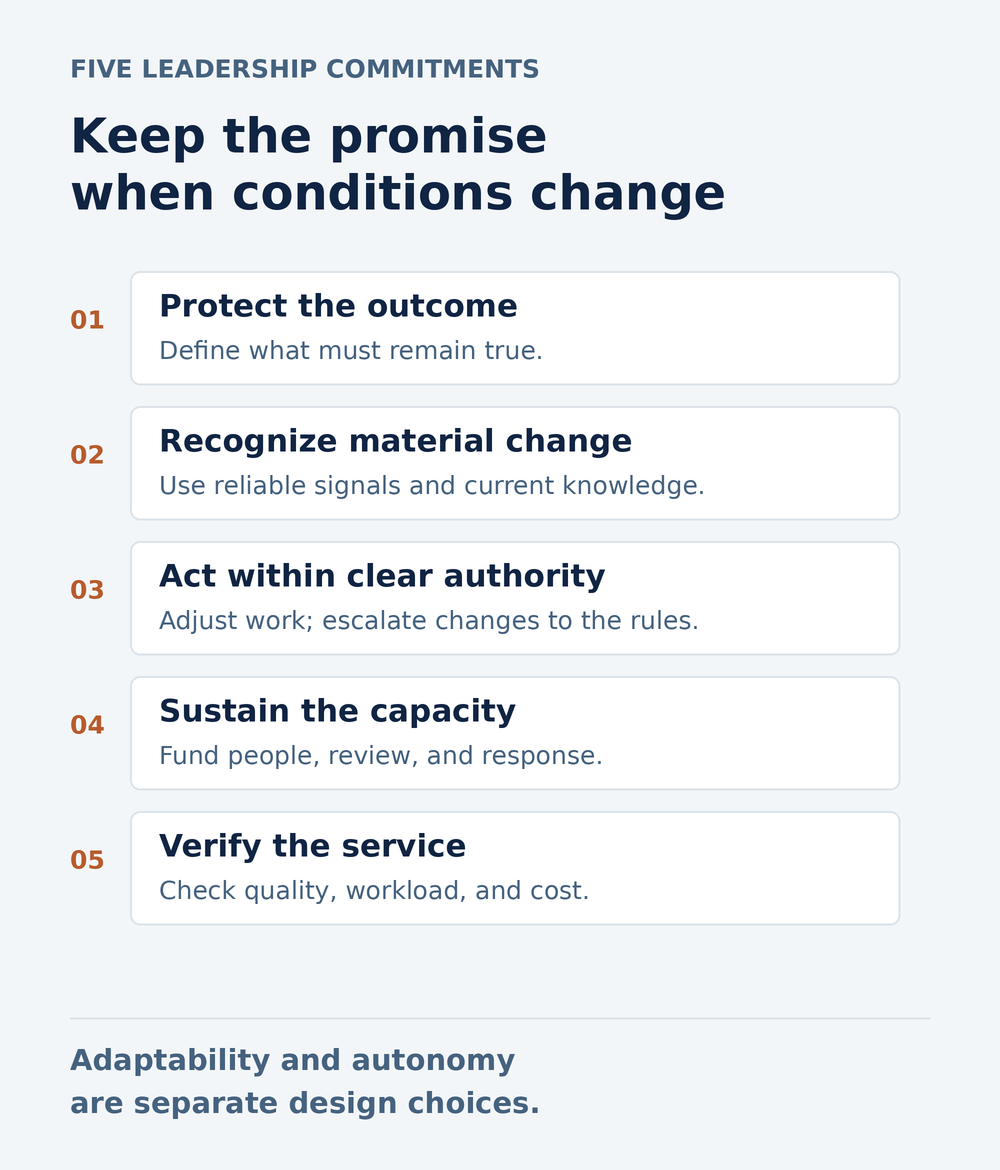
Protect the service promise as conditions change. These commitments apply together; the appropriate level of system autonomy is a separate decision.
The approach
Start with the outcome that must hold
For this article, adaptive operations means a sustained organizational ability to recognize material change, select an appropriate response, coordinate its execution, and establish whether it helped. People can perform much of that work. Reliable automation and AI assistance can support it. The capability belongs to the operating system as a whole.
Start by naming the service promise: accurate claims handling, dependable fulfillment, timely customer support, or another outcome the business is accountable for. Then identify the kinds of variation that could put it at risk. A growing exception queue matters because of what it reveals about that promise, not simply because the queue is large.
There is an established foundation for this way of thinking. The Basel Committee’s March 2021 principles frame banking resilience around continuing critical operations through disruption. They also call for testing disruption scenarios and mapping the dependencies needed to deliver those operations. Basel Committee, *Principles for Operational Resilience*, definition and Principles 3–4, 31 March 2021.
My broader inference is that adaptability should be assessed at the level of the service and its dependencies. Faster triage achieves little if the specialist team receiving the work cannot absorb it. The same reasoning applies to opportunity: an increase in demand becomes valuable only if the operation can respond without undermining the customer promise.
Separate adapting the work from expanding authority
Adaptability concerns how well the operation responds to changed conditions. Autonomy concerns which decisions and actions a system may undertake without individual approval. They interact, but one does not establish the other.
A team using reliable signals and an agreed response plan can adapt while retaining human decisions. A highly automated workflow can still be fragile when circumstances move beyond its assumptions. Leaders should therefore assess responsiveness and delegated authority separately.
The practical boundary is between choosing an authorized response and changing the rules that authorize it. Reassigning work among qualified teams under an approved routing plan is one decision. Altering eligibility criteria, waiving an evidence requirement, or increasing payment authority is another. Faster execution does not confer permission to make the second kind of change.
When evidence is incomplete, a controlled pause, narrower scope, or specialist review can be the appropriate response. An operation that can reduce its reliance on automation when conditions become uncertain has a useful adaptive capability.
NIST’s AI Risk Management Framework 1.0 includes production monitoring and post-deployment arrangements for user feedback, override, incident response, recovery, and change management. That supports treating intervention as part of the operating design. It does not establish that an AI system should rewrite its own policies or continuously retrain itself. NIST, *AI RMF 1.0*, MEASURE 2.4 and MANAGE 4.1, 26 January 2023.
A demand surge tests the whole operation
Hypothetical example — insurance claims operations. An insurer has automated claim intake and document routing. Following severe weather, claim volume rises and the mix of cases changes. Intake keeps moving, but specialist reviews accumulate and customers make repeated requests for updates.
Adding intake capacity could send more work into the same constraint. The adaptive response begins by establishing where service is deteriorating: which case types are waiting, what expertise they require, whether the necessary evidence is available, and how the delay affects customers.
Under a proposed design, a named Operating owner for claims coordinates the response across intake, specialist review, and customer communication. Approved routing rules allow work to move among qualified teams within capacity limits. AI assistance could summarize incoming information, subject to evaluation and review appropriate to its use. Ambiguous cases retain specialist handling. Coverage rules, evidence requirements, and payment authority remain under their designated owners.
Staff receive the reason for the temporary routing change, the guidance they should use, and a clear way to challenge a misrouted case. They also need time to make those judgments. Moving complex work to an already overloaded team merely relocates the delay.
The expected benefits are shorter avoidable waits, fewer repeated contacts, and more consistent handling. None is an achieved result in this example. Test the design against comparable cases and demand conditions, tracking time to resolution, reopened cases, review quality, customer contacts, and staff workload. Include the cost of additional review, technology, and coordination.
If the queue falls because cases are closed prematurely, the response has failed its purpose. If service improves because qualified people can respond sooner with reliable context, the operation has become more adaptive—even if final decisions remain human.
Fund the capacity to keep responding
Adaptability has a running cost. Knowledge must remain current. Response plans need rehearsal. Employees need capacity to examine unusual cases and contribute improvements. Monitoring needs someone with both the authority and the time to act on what it reveals.
These costs belong in the operating case. Funding the initial automation while leaving its knowledge, response capacity, and review work unfunded creates a capability that depends on people absorbing the shortfall.
There is also a choice about how much flexibility is worthwhile. Stable, well-understood work may be served by simple rules, scheduled review, and an occasional human intervention. Work exposed to consequential variation may justify more frequent monitoring, alternative routes, or reserved specialist capacity. The additional investment should correspond to the value of responding better and the consequences of responding badly.
Not every fluctuation warrants a change. Teams need to distinguish ordinary variation, unreliable data, and a material shift in the work. Repeatedly changing instructions on weak evidence can increase confusion and rework. The response rhythm should match the decision’s consequence and the speed at which harm or opportunity develops.
Employee feedback matters here. A rising override rate could indicate weak recommendations, outdated guidance, changed work, or a sensible exercise of judgment. Examine the cases before treating the rate as a performance failure. People must be able to expose a limitation without being penalized for reducing automation volume.
Measure the service through the change
Keep efficiency measures, and add evidence about what happened while the operation adjusted. A compact review can use the following questions.
| Leadership question | Evidence to examine |
|---|---|
| Did we recognize the material change soon enough? | Time from the earliest reliable signal to recognition by the Outcome owner; avoidable alerts and missed signals. |
| Did an appropriate response reach the work? | Time to put an authorized response into use; whether staff had the knowledge and capacity to apply it. |
| Did the intended outcome hold? | Service quality, customer delays, errors, rework, and control failures across the affected workflow. |
| Can we sustain the response? | Staff workload, specialist review effort, operating cost, and dependence on temporary workarounds. |
Use comparable workloads and record changes in case mix. Otherwise, an easier period can look like a better operating model. Look beyond averages where they hide prolonged delays or poor outcomes for a smaller group of customers.
Adaptive operations is the broader performance ambition. Self-healing applies that ambition to operational friction and recurring failure. The Continuous Evolution Loop explains how evidence changes future practice. Distinguishing these purposes keeps the immediate response from being mistaken for a lasting improvement.
Within the Transformation Operating Map, this argument begins in Frame the Opportunity: identify which changes the business needs to handle better. Improve Continuously tests whether that capability is strengthening over time. Wider autonomy can follow where justified; it is not the measure of success.
Leadership takeaway
Put one service through a change test
Choose one business service where changing conditions have a meaningful cost. Ask its owner and frontline team to walk through a plausible demand surge, policy change, or loss of a key dependency.
Trace how the operation would recognize the change, who could authorize a response, and what the people doing the work would need. Identify what must remain protected and how the team would establish that the response helped. Include the capacity and cost of any fallback.
Use the exercise to select one constraint to fix before approving further expansion. The next investment might be better knowledge, clearer authority, specialist capacity, or a simpler workflow. Judge it by the improvement in the service’s ability to respond and keep its promise.
Sources and further reading
Evidence used in this article
- Basel Committee on Banking Supervision — Principles for Operational Resilience, 31 March 2021. The definition of operational resilience and Principles 3–4 support the discussion of service continuity, scenario testing, and dependencies. The guidance concerns banks; the broader application is the author’s inference.
- National Institute of Standards and Technology — Artificial Intelligence Risk Management Framework (AI RMF 1.0), 26 January 2023. MEASURE 2.4 and MANAGE 4.1 support production monitoring, feedback, intervention, and managed change. This is voluntary guidance, not evidence of a financial return from adaptive operations.