 RePerspective Labs
INSIGHT
Executive Framework
The Continuous Evolution Loop: Turning Operational Signals into Improvement
How leaders decide what to change, establish whether it worked, and carry the learning into the next operating decision.
Executive summary
Operational signals reveal where the design of work is losing touch with reality. Turning them into improvement requires a reliable path from evidence to an accountable decision, a proportionate intervention, and a verified outcome. Leaders should distinguish routine tuning from changes to decision logic and from questions that warrant redesigning the operating model. They should also protect employee feedback and test whether local gains improve the whole workflow. The Continuous Evolution Loop connects these responsibilities. Its value lies in making learning durable: changing the knowledge, controls, work design, or investment choices that shape what happens next.
The question
What changes after the same problem returns?
A team clears an exception queue. A recurring error receives another workaround. An AI recommendation is corrected before it reaches a customer. Service continues, and the performance report may remain reassuring.
But what happens to the lesson?
If the next employee must rediscover the same exception, or the next system release repeats the same assumption, the organization has recovered without retaining enough of what it learned. Equally, a team may deploy frequent improvements without establishing whether the changes helped customers, reduced total effort, or shifted the problem downstream.
AI-enabled work makes this distinction consequential. A recommendation can change when its source material changes, even if the workflow itself is untouched. Leaders therefore need to know which operational signals warrant action, who can authorize the response, and what evidence would justify keeping the change.
My perspective
I would judge an improvement loop by whether a lesson changes the next operating decision. That requires a named outcome owner, a proportionate change path, and evidence that the intervention worked. The loop must also be allowed to conclude that the workflow should be redesigned, the ambition narrowed, or the capability retired.
Shashi Sethi
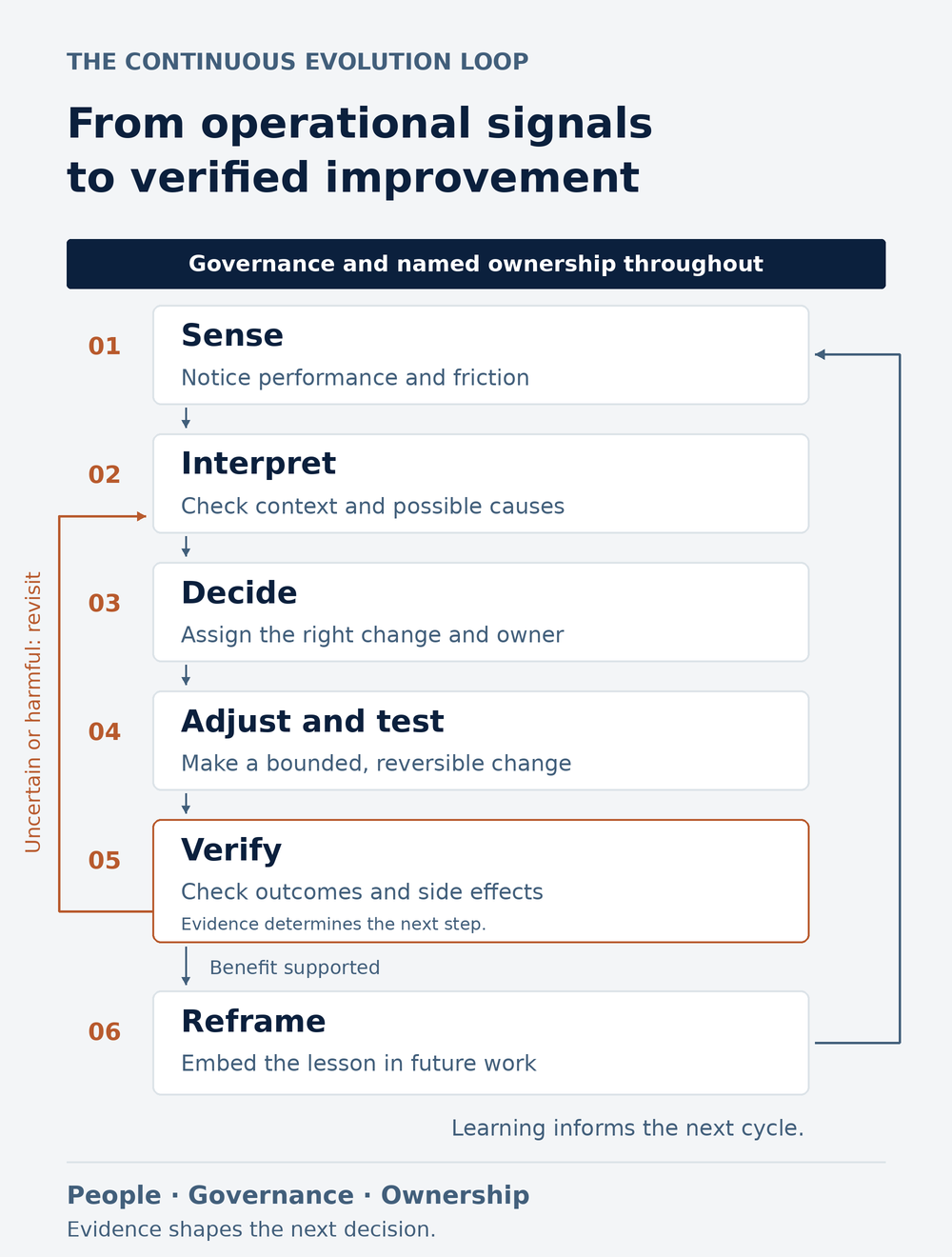
Operational evidence becomes durable learning when a governed change is tested, its outcome is verified, and the lesson informs future work.
The approach
Begin with the outcome the operation must protect
The loop begins with a business purpose: resolve a customer request correctly, complete a payment on time, or produce a decision that the organization can explain and stand behind. That purpose determines which signals matter and which trade-offs are acceptable.
A shorter processing time is useful only in relation to that outcome. If it creates more rework for another team or makes a decision harder to challenge, the apparent gain requires examination. The same applies to a reduction in human review: its value depends on whether decision quality and accountability hold.
The Self-Healing Enterprise describes the wider capability to detect friction, interpret context, and respond within boundaries. This article develops its learning discipline: how operational experience earns a change to the way future work is performed. It also applies to improving a reliable process when a better way becomes possible, before a failure forces attention.
Treat signals as evidence to investigate
Read performance, friction, decision, knowledge, control, and adoption signals together. Each offers a partial view.
A rising override rate could indicate inadequate recommendations, missing contract terms, a different mix of cases, or better employee judgment. A falling rate could reflect improved quality—or reluctance to challenge the system. Neither direction establishes the answer by itself.
For an important pattern, examine representative cases, including apparently successful ones. Ask the people doing the work what they saw, which information they used, and what happened after their decision. Compare similar work and account for changes in volume, complexity, staffing, and reporting. AI can help organize this evidence and suggest explanations; accountable owners should resolve consequential judgments with the relevant expertise.
The reporting environment matters. Google’s Site Reliability Workbook describes how blame in incident reviews can encourage people to conceal facts needed to prevent recurrence. That is a documented lesson from software operations; applying it to employee feedback in AI-enabled workflows is an operating-design inference. Google, “Postmortem Culture: Learning from Failure,” 2018.
Give staff time to explain workarounds and a visible response to what they report. Explain how feedback will be used. A useful review should make it easier to surface a problem and understand the resulting decision.
Match the change to its consequence
Three tiers connect a proposed change with the authority needed to make it. Classification should follow its effect on work, decisions, and risk.
| Change tier | What belongs here | Decision responsibility |
|---|---|---|
| Routine tuning | Refinement inside an explicitly approved range, without changing policy meaning, delegated authority, or material risk. | A process or support owner with documented delegation. |
| Controlled improvement | Changes to knowledge used in decisions, decision logic, handoffs, or review arrangements that require evaluation and approval. | One Outcome owner, with the required process, technology, knowledge, and control approvals. |
| Strategic reframing | Changes to the operating purpose, service model, risk appetite, funding, or continued use of a capability. | The executive accountable for the outcome, through the appropriate decision forum. |
A small edit to a knowledge source can materially change an AI recommendation. It should be classified by that consequence. Similarly, a series of individually modest adjustments can collectively expand authority; reviews need to consider their combined effect.
Governance belongs across the loop, beginning before an intervention is released. NIST’s AI Risk Management Framework 1.0 connects monitoring after deployment with user input, overrides, change management, and measurable continual improvement. It supports these disciplines without prescribing this article’s three tiers. NIST, January 2023, MANAGE 4.1–4.2.
A credible threat to customers or operations should enter the established incident response immediately. Less urgent uncertainty may justify further observation. The cadence should follow consequence and the time needed to learn.
Make verification part of delivery
The loop can be expressed as six connected movements: sense, interpret, decide, adjust and test, verify, and reframe. Governance and ownership apply throughout. Verification determines whether a change should become normal practice, be revised, or be withdrawn.
Before changing the operation, record the expected benefit, the baseline, the affected population, the measures that must remain acceptable, and the conditions for stopping or reversing the intervention. Agree who will review the result and when enough relevant work will have passed through to make that review meaningful.
The Institute for Healthcare Improvement’s guidance on testing changes uses Plan–Do–Study–Act cycles to compare observations with predictions, assess side effects, and refine changes in their local context. The principle is useful here: implementation is followed by examination of what actually happened. IHI, “Model for Improvement: Testing Changes,” undated; accessed 12 September 2026.
Use comparable cases or a suitable comparison group where practical. Keep other material changes stable during the test where possible. A before-and-after improvement can be encouraging without establishing that the intervention caused it.
Review the whole workflow: recurrence among comparable cases, decision quality, customer effects, downstream rework, and total operating effort. Include the ongoing cost of monitoring and human review. Released time becomes financial savings only when an actual cost changes.
Treat a deployed change as a hypothesis until its effect on the whole operation has been checked.
A hypothetical example: when invoice overrides reveal an upstream problem
Consider a hypothetical finance operation using AI to recommend resolutions for invoice exceptions. Staff increasingly override recommendations for one supplier contract type. The intended outcome is accurate, timely payment with defensible handling of exceptions.
The Operating owner samples overridden and accepted recommendations with experienced staff. Suppose this examination finds that the recommendation step cannot access the approved terms for that contract type. The immediate response is to route affected cases to qualified reviewers under the existing exception process while the gap is investigated.
The proposed improvement is to make the approved terms available at the decision point and test whether recommendations apply them correctly. The knowledge owner confirms their authority and scope; the Outcome owner approves the test with the relevant Control lead. Historical cases support evaluation before a limited operational trial. Staff retain the ability to challenge recommendations, and the prior routing remains available.
The hypothesis is that better context will improve resolution quality and reduce avoidable corrections. Evidence would include fewer incorrect resolutions in reviewed samples and less repeated rework, without unacceptable delays or additional control failures. An improvement in acceptance rates alone would be insufficient. If quality remains weak or review effort rises excessively, the proposed change needs revision.
The deeper lesson concerns contract intake. If approved terms repeatedly fail to reach the payment process, retrieval fixes will keep treating the same dependency. The executive decision becomes whether to redesign how nonstandard terms are captured, owned, and carried into downstream work.
These are proposed decisions and evaluation criteria, not reported results.
Make the lesson part of how the business runs
A useful lesson needs a durable destination: approved knowledge, a decision rule, a control, a role definition, a test case, or an investment decision. Record what changed, why it changed, where it applies, and what would justify revisiting it. Update the affected guidance and explain the change to the people who must use it.
Keep a concise record linking the original signal to the decision, owner, test, result, and next review. Retain unsuccessful tests and decisions to defer, with their reasons and reopening conditions. This preserves useful evidence when people or suppliers change.
The Outcome owner also needs capacity to act. Reserve time for investigation and evaluation, and make cross-team dependencies visible in the improvement backlog. A requirement to learn has little effect if delivery targets consume all available capacity.
Recurring friction can eventually challenge the operating case itself. If the cost of supervision, exceptions, and continual correction exceeds the capability’s value, narrowing or retiring it deserves consideration. In the Transformation Operating Map, this is how Improve Continuously informs Frame the Opportunity: experience changes what the enterprise chooses to invest in next.
Leadership takeaway
Ask for the evidence behind one completed improvement
At the next operating review, select one change that the team considers complete. Ask the outcome owner to trace it from the original signal through the decision and intervention to the observed result.
Can the team explain what improved, for whom, and against which baseline? Did the gain survive consideration of downstream work, customer effects, and the cost of keeping it reliable? Where is the lesson now embedded so that another employee or team can use it?
If those answers are incomplete, keep the outcome review open and assign the missing work. Then agree which recurring pattern deserves a larger decision about the operating model.
Sources and further reading
Sources used in this article:
- NIST — Artificial Intelligence Risk Management Framework, AI RMF 1.0, January 2023. MANAGE 4.1–4.2 addresses monitoring after deployment, feedback, change management, and measurable improvement.
- Institute for Healthcare Improvement — Model for Improvement: Testing Changes, undated; accessed 12 September 2026. Guidance on testing changes, examining results, and learning before broader implementation.
- *Google — Postmortem Culture: Learning from Failure, The Site Reliability Workbook, 2018.* Published operating practices concerning candid incident analysis, ownership, and follow-through.