 RePerspective Labs
INSIGHT
Playbook
From Project Team to Business Ownership: The Handoff Model for AI-Enabled Operations
What leaders must put in place so operating teams can sustain value, exercise judgment, and manage change after delivery ends.
Executive summary
An AI-enabled capability becomes sustainable when the people accountable for its business outcome can direct its operation, respond to changing conditions, and fund the work it creates. A successful launch does not establish those abilities. This article argues that business accountability should begin before implementation, while the transfer of day-to-day operating responsibility should depend on demonstrated readiness. Leaders must connect ownership with decision authority, workforce capacity, continuing technical support, and an explicit acceptance decision. The consequence is a different standard for project closure: the receiving organization can sustain and govern the capability without relying on temporary project arrangements.
The question
When can the project team responsibly step back?
A capability can be in production while the project team still holds the operation together. Specialists interpret unusual outputs, explain undocumented assumptions, and resolve exceptions through personal contacts. The business sees a working service. The effort that makes it work remains inside a temporary delivery arrangement.
The tension appears when that arrangement ends. An operating manager inherits responsibility for performance, but another team controls the changes, specialist time remains unfunded, and the people handling exceptions have little room to absorb the work. The owner is named; the means to own the outcome are incomplete.
This is the executive question behind handoff: what must the receiving organization be able to decide, do, and sustain before project support can withdraw?
The answer matters even when the technology is performing as designed. Ownership concerns the continuing health of the operation, including the decisions required when its original assumptions stop holding.
My perspective
I would approve project exit only when the receiving team has demonstrated that it can exercise the authority it is being given, with the people and support to sustain it. Business ownership begins with accountability for the outcome and becomes credible through the capacity to act on that accountability.
Shashi Sethi
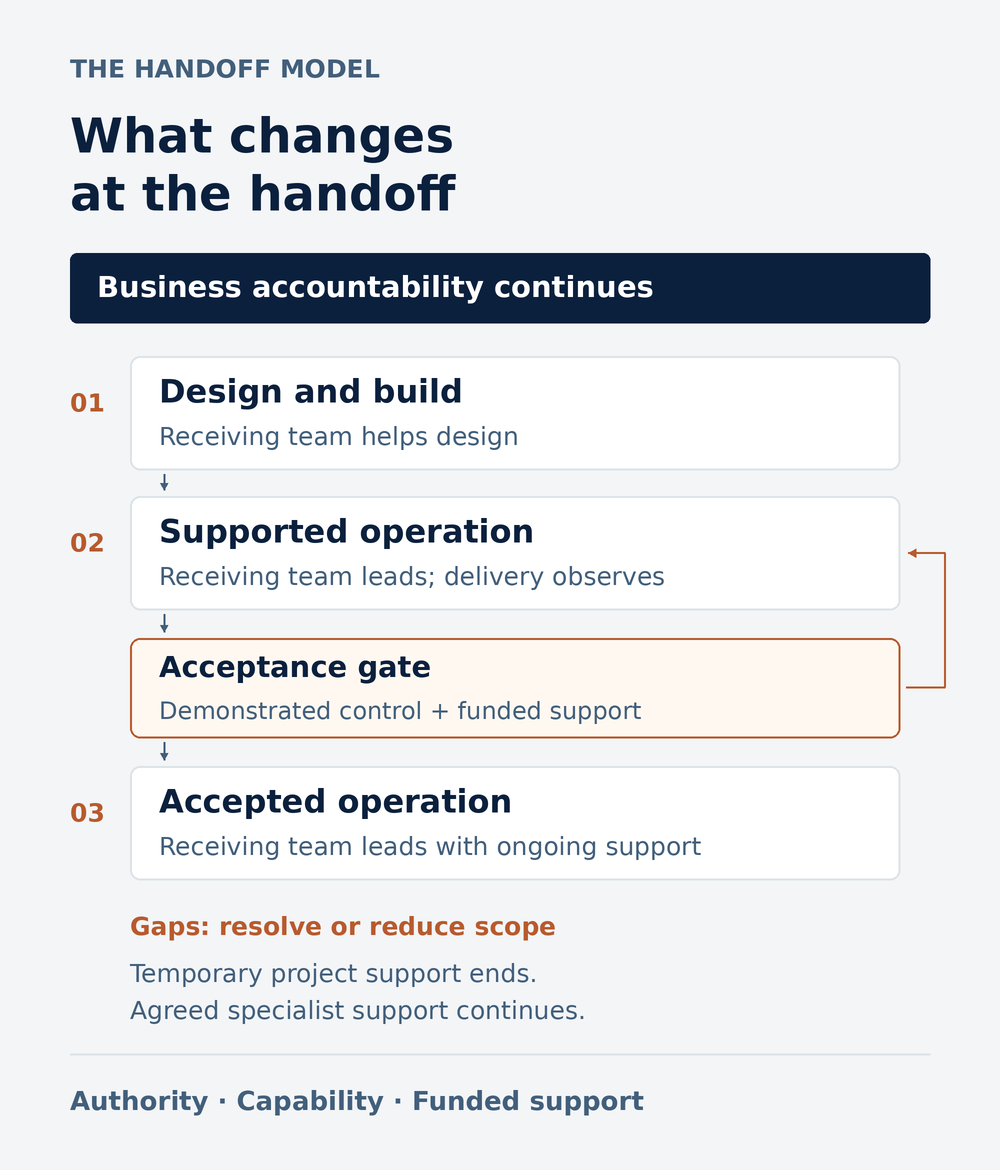
Business accountability continues throughout. Temporary delivery support ends after the receiving team demonstrates control and the organization commits to continuing support.
The approach
Business accountability begins before the handoff
The Outcome owner should help define the outcome, acceptable trade-offs, and operating requirements before implementation begins. Waiting until closure to appoint that person asks them to accept decisions they had little opportunity to shape.
The Outcome owner answers for the end-to-end result and its funding. The Operating owner runs the capability day to day. The Knowledge owner maintains authoritative context, the Technology owner maintains the technical service, and the Control lead challenges and checks the control design. The Sponsor resolves executive priorities and cross-team commitments. One person may hold more than one role; each responsibility still needs to be explicit.
What changes at handoff is who leads daily operation and how the remaining delivery obligations are resolved. The project team transfers practical knowledge, access, operating responsibilities, and unfinished commitments to named recipients. Business accountability continues through that transition.
This distinction also applies when the organization uses a permanent product team. There may be no wholesale team exit, but the business still needs to accept the operational consequences of each material release. Shared platforms and specialist services can remain centrally owned. Their responsibilities need to be explicit within the business operation that depends on them.
Established delivery guidance supports treating transition as a designed part of the work. The UK government’s GovS 002, version 2.1, includes formal acceptance, service continuity, and ownership transfer within transition planning. Its closure guidance also calls for continuing risks, actions, and benefits tracking to be accepted by an appropriate business authority. These are government delivery expectations; their relevance here is the discipline of explicit acceptance. Government Project Delivery, September 2025, sections 6.4.8 and 8.8.
Within the RePerspective Labs Transformation Operating Map, this is the purpose of Transfer Ownership: making the receiving organization ready to carry the operation forward.
Give each owner authority they can exercise
An ownership model needs to connect responsibilities with actual decisions. The following division is a starting point to adapt to the organization’s structure and existing delegations.
These responsibilities need named people and deputies. Smaller organizations may combine some roles, while preserving any required independence. Operating and technology teams remain responsible for performing their assigned controls; oversight does not absorb that responsibility.
Assign critical data and knowledge maintenance explicitly as well. Someone must be able to correct an authoritative source, approve a policy update, and tell the operating team when an input can no longer be trusted.
The decisive test is whether the owner can obtain action. An Operating owner who may identify a problem but cannot invoke a fallback or obtain a timely specialist response has only partial control. An Outcome owner who may request an improvement but has no route to funding or prioritization cannot sustain the capability’s value.
Agree these routes before acceptance, including who can pause use and who authorizes resumption. A local owner’s mandate must remain within enterprise risk and approval boundaries.
Let the receiving team demonstrate ownership
Documentation and training prepare people to operate. The handoff decision needs evidence that they can use that preparation.
I would use a period of supported operation in which the receiving team leads and the delivery team observes, intervening through an agreed escalation route. The operating team runs the review, interprets performance, assigns an exception, and obtains support through the channels it will have after project exit. Any intervention that depends on an undocumented project contact becomes a gap to resolve or a continuing service to formalize.
Choose the evidence period around the work’s actual variation: shifts, business cycles, important exception types, and foreseeable disruptions. Elapsed time alone provides little assurance. Uncommon but consequential situations should be rehearsed safely, including a loss of a critical input or a decision to suspend the AI-enabled step. A quiet period cannot establish that these responses will work.
The AI-specific concern is that performance can change with data and operating context. NIST’s AI Risk Management Framework 1.0 addresses this through clear responsibilities and continued monitoring after deployment, including user feedback, overrides, recovery, and change management. That supports testing the receiving team’s ability to respond to change as well as to run today’s workflow. NIST, January 2023, GOVERN 2 and MANAGE 4.1.
A supplier change reveals the operating responsibility
Hypothetical example. A shared-services team uses AI to extract invoice information and recommend how exceptions should be resolved. Payment authorization remains with designated people. A supplier introduces a new document format, and incorrect extractions begin increasing rework.
With an incomplete handoff, operations sends a support ticket and waits. Support confirms the service is available. The delivery specialist who understands the extraction assumptions has moved on, while staff quietly repair the output to keep payments moving. Technical availability conceals the growing operating cost.
Under the proposed arrangement, the Operating owner recognizes the change through quality checks and frontline reports, routes the affected supplier’s invoices to an approved manual path, and invokes named technical support. The fallback has staffing and queue limits, so the Outcome owner can decide whether additional capacity or a temporary scope reduction is necessary.
Technology investigates the cause before proposing a change. The relevant data or knowledge owner verifies the inputs, designated reviewers assess the change, and an authorized owner approves resumption after appropriate evaluation. The team then checks the affected work for corrections still required.
The proposed benefit is earlier containment and clearer resolution. It would be tested through detection time, rework, delayed invoices, staff effort, and reliance on temporary project help. No achieved improvement is assumed.
Fund the operation the business is accepting
Handoff exposes whether the operating case included the full cost of the capability. Someone must fund ongoing evaluation, knowledge maintenance, technical support, exception handling, staff development, and controlled improvement. These costs may sit in several budgets, but the service commitments need to add up to a viable operation.
The receiving team also needs capacity for its changed work. If staff inherit more complex exceptions and judgment responsibilities, leadership must decide what work will be removed, reassigned, or resourced. Training cannot compensate for a workload that leaves no time to investigate a consequential recommendation.
Separate the recurring cost of operating the service from remaining delivery defects and future enhancements. Give each an owner and a funding route. Where a central team supplies specialist support, agree its response commitments and how competing demands are prioritized.
Continue evaluating the business outcome alongside those costs. Time released by automation is available capacity; it becomes a realized benefit through a specific operating change. Recurring manual correction and support effort belong in that assessment. If the sustainable operating cost weakens the case, leaders should revisit scope, service design, or continued use.
A business-led performance review is where those decisions are made. Its purpose is to connect service quality, user experience, risk, and value with action. A meeting schedule becomes useful only when someone can commit resources and follow through.
Make acceptance specific, and allow it to be withheld
Before exit, the Outcome owner, receiving operations lead, and support owner should agree the scope being accepted, the evidence of readiness, and the obligations that continue. Required risk decisions should follow existing delegated authority. The delivery lead remains responsible for making outstanding commitments visible and assigning their resolution.
Record the decision in a compact acceptance record: approved use and limits; named decision owners and deputies; demonstrated operating and fallback capability; staffing and funded support; unresolved issues and accepted residual risks; and the next review with conditions that require earlier intervention.
Three decisions are legitimate:
- Accept: the agreed scope is supportable, the receiving team has demonstrated its responsibilities, and continuing obligations have owners and funding.
- Accept a limited scope with conditions: a restricted operation is supportable while specific gaps are closed. Record each condition’s owner, resources, deadline, and the action required if it remains unresolved.
- Defer exit: a material requirement remains unmet. Leadership funds a bounded extension, reduces scope, or arranges safe withdrawal of the capability.
Conditional acceptance must not disguise the absence of authority, essential controls, or a workable fallback. Nor should a team be compelled to accept unresolved risks beyond its mandate because project funding is ending.
Acceptance applies to a defined operating scope. A material change in decision authority, business use, or dependencies can require renewed review. NIST similarly calls for assigned responsibilities and mechanisms to disengage or deactivate AI systems when their performance or outcomes no longer fit intended use. NIST AI RMF 1.0, MANAGE 2.4.
Where continued operation is no longer justified, ownership includes directing an orderly retirement: preserve necessary records, settle work already in progress, and move the service to an agreed alternative. Closing a project should leave the enterprise able to make that decision.
Leadership takeaway
Ask the Operating owner in the receiving team to lead the final review
At the next proposed project closure, ask the Operating owner in the receiving team to walk through a realistic operating problem with the delivery team observing. Use the evidence, access, people, and support arrangements that will exist after exit.
Can that owner recognize the problem, direct a response, obtain specialist help, and explain who can authorize the next change? Can the team sustain that response within its actual workload and budget?
Use the answers to make an explicit acceptance decision. Where gaps remain, assign the work and funding required to close them, or narrow the scope being accepted. The sponsor’s responsibility is to resolve the mismatch between expectations and operating capacity.
The question to leave on the table is: what will this owner be able to do when the outcome is at risk—and have we made that ability real?
Sources and further reading
Evidence used in this article:
- NIST — Artificial Intelligence Risk Management Framework (AI RMF 1.0), January 2023. GOVERN 2 addresses accountable, empowered, trained teams; MANAGE 2.4 addresses disengagement; MANAGE 4.1 addresses monitoring and response after deployment. Voluntary, cross-sector guidance.
- Government Project Delivery — Government Functional Standard GovS 002: Project delivery, version 2.1, 1 September 2025; HTML page last modified 29 March 2026. Sections 6.4.8 and 8.8 address accepted continuing responsibilities and planned transition. Its formal scope is UK government delivery; the article draws a management implication for enterprise handoffs.