 RePerspective Labs
INSIGHT
Founder's Perspective
Leadership Judgment in the Age of AI
How leaders define good decisions, make challenge workable, and keep AI-enabled operations accountable as conditions change.
Executive summary
Leadership judgment shapes the conditions under which AI influences enterprise decisions: what counts as success, whose interests matter, which trade-offs are acceptable, and when an established approach should change. Clear authority boundaries are necessary, but a system can operate within them and still pursue an incomplete objective. Human approval alone offers no assurance of better judgment. Leaders need to make decision criteria explicit, give people the evidence and capacity to challenge recommendations, and examine outcomes that may contradict the original business case. The aim is to improve the quality of decisions while preserving the organization’s ability to recognize and correct its own assumptions.
The question
Who decides what a good decision looks like?
An executive approves an AI initiative to improve service. The team measures turnaround time, automates routine work, and keeps a person available for exceptions. The design appears sensible. Yet an unresolved question sits underneath it: what should happen when faster processing conflicts with the outcome the customer actually needs?
An AI-supported recommendation reflects choices about objectives, evidence, priorities, and acceptable consequences. Some of those choices are deliberate. Others enter through an inherited performance measure, a historical pattern, or the way a team has learned to secure approval.
Those choices deserve leadership attention before they become routine. A system might follow its instructions accurately while advancing a narrow version of the enterprise’s purpose. A human reviewer might recognize the problem yet lack the time, authority, or incentive to change the response.
The executive question is therefore about the quality of the decision environment leaders have created, including the assumptions they are prepared to reconsider.
My perspective
I would judge an AI initiative by whether the business can explain what a good decision means, recognize when that definition is failing, and change course. Leaders must be willing to revise the priorities and incentives they approved. Without that willingness, even well-governed execution can repeatedly deliver an outcome the enterprise should question.
Shashi Sethi
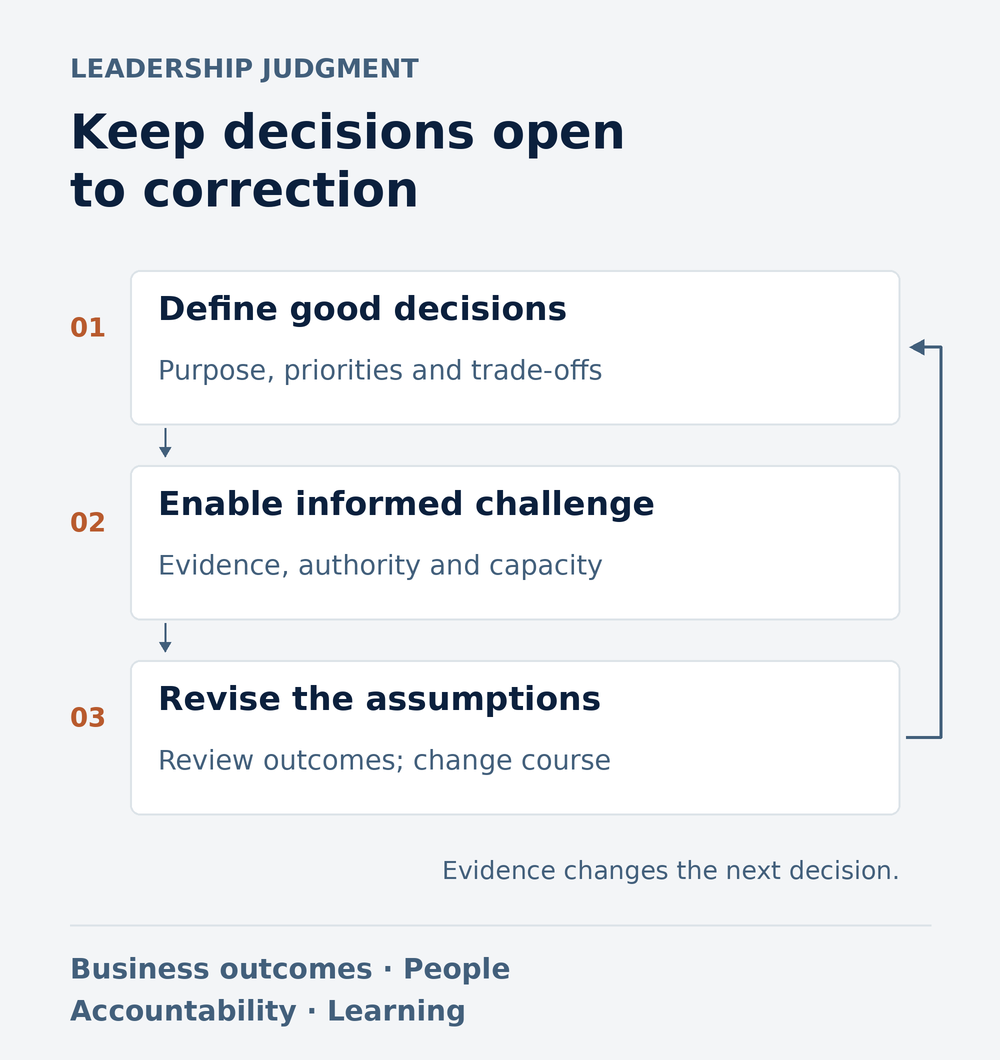
Leadership judgment connects clear decision criteria, informed challenge, and evidence that changes the assumptions behind future decisions.
The approach
Define the trade-off before delegating the decision
Purpose becomes useful when it helps resolve a conflict. “Improve customer service” gives limited guidance when one option reduces handling cost and another prevents a customer from waiting through an unresolved problem.
Leaders should establish what the operation is trying to improve, what it must protect, and which trade-offs people may resolve without further approval. That requires enough specificity to guide a difficult case. If timely access for customers facing serious disruption matters, it must influence queue priorities, staffing, and performance reviews.
The leadership work includes deciding which compromises are acceptable. A team may need to accept a higher handling cost for some cases, preserve discretion for unusual circumstances, or narrow the scope of automation until missing context can be supplied. These choices have economic consequences and should appear in the operating case.
Don’t outsource your brain; the muscle you can. The enterprise’s “brain” is the judgment behind its priorities, acceptable compromises, resource commitments, and ownership of business consequences. Leaders must retain the understanding and authority to make those choices. AI agents and consulting firms can help develop options and challenge assumptions; they cannot take over that responsibility.
The “muscle” is the work that carries an agreed direction into practice. Systems and vendors may perform it within a clear mandate: the intended outcome, permitted actions, acceptance criteria, and route for exceptions. A vision becomes delegable work only when those conditions are explicit.
NIST’s voluntary AI Risk Management Framework 1.0, published in January 2023, assigns executive leadership responsibility for AI risk decisions and calls for explicit roles in human–AI arrangements. It provides governance guidance, rather than evidence that a particular arrangement will improve performance. See GOVERN 2.3 and 3.2.
The practical test is whether two capable people can explain the same priority when the easy answer and the intended outcome diverge.
Use AI to test your own position
Executive judgment should remain open to challenge. Experience provides context, but it also brings familiar assumptions about customers, organizational capacity, and what has worked before.
Before asking AI to assess a proposal, write down the intended outcome, the alternatives under consideration, and the evidence that would change your view. Then use it to explore a credible alternative, identify missing information, or examine how the preferred approach might fail under different conditions.
Leaders should use AI directly as cognitive muscle: help with synthesizing information, developing alternatives, and examining assumptions. For a consequential proposal, use more than one approved model when it adds a useful challenge. Ask one to develop an operating option and another to examine its assumptions or propose a different design. Compare the reasoning and investigate disagreements; agreement between models is not validation. Bring people who understand the work into the assessment and verify consequential claims.
Use this exploration to define the customer experience, allocation of work, and decisions the future operation should support. Establish an internally owned direction before commissioning a systems integrator or external development team. Treat that direction as a working hypothesis: partners should help test feasibility, and operating evidence should refine it. Design the Future Operation First develops that future-first perspective; Working with AI When the Problem Is Still Taking Shape offers a practical way to explore unresolved questions.
This also means examining how the executive team uses AI. A persuasive case for a preferred investment can make agreement easier without making the investment better. Ask the team to show which assumption it challenged and whether the exercise changed the proposal.
A 2025 study by Hao-Ping Lee and colleagues surveyed 319 knowledge workers about their use of generative AI. Higher confidence in AI was associated with less reported critical thinking; greater confidence in one’s own task capability was associated with more. These are self-reported associations, not proof that AI causes lasting loss of judgment. The findings make confidence itself worth examining. See the CHI 2025 study on generative AI and critical thinking.
For a leader, the discipline is to remain accountable for the reasoning behind the choice, including when AI supplies much of the analysis.
Give challenge a workable place in the operation
The same discipline needs to survive in everyday work. A person asked to review an AI recommendation needs access to relevant evidence, an understanding of the applicable decision criteria, and authority to intervene. The operating model must also provide time to exercise that authority.
Research cautions against treating human involvement as an automatic improvement. A 2024 meta-analysis of 106 experiments found that human–AI combinations, on average, outperformed humans alone but underperformed the better of humans or AI alone on the measures studied. Results varied by task. The underlying studies were published between January 2020 and June 2023, so the finding does not establish how a current enterprise deployment will perform. It supports testing the combined arrangement. See Vaccaro, Almaatouq, and Malone’s review of human–AI performance.
My operating conclusion is that review capacity belongs in the business case. If the benefit estimate assumes that nearly all human effort disappears, there may be little capacity left to resolve the cases that still require judgment. Teams then face a conflict between the quality expected of them and the volume they are expected to clear.
Leaders should make that conflict visible. Measure the quality and timeliness of exception handling alongside throughput. Give reviewers a route to question an unsuitable policy or objective, as well as an individual recommendation. Evaluate an override on its reasons and consequences; neither accepting nor rejecting AI is inherently the better decision.
That is how judgment literacy becomes observable: people can explain what evidence they used, what remained uncertain, and why they acted or escalated.
A faster queue can still serve the wrong priority
Hypothetical operating example. Consider a property insurer introducing AI assistance to prioritize claims after a severe storm. The stated purpose is timely customer recovery with sustainable handling costs. AI helps summarize case information and recommend the order of review. Coverage and settlement decisions sit outside this proposed scope.
Suppose the queue ranking favors cases that appear easiest to complete. Daily closures could improve while customers with complicated, urgent circumstances wait longer. A supervisor approving the ranked queue may see accurate summaries and sensible recommendations against the throughput target. The weakness lies in what the target leaves out.
The executive response starts with a decision about service priorities. The operations leader should agree how urgency, waiting time, and case complexity affect priority, with claims specialists testing whether those criteria reflect the intended customer outcome. Urgency cannot simply be inferred from how complete a claim file is. Incomplete information may itself require investigation.
That choice changes the work. Reviewers need relevant case context and authority to reprioritize. The operating plan needs enough capacity for complex cases. Performance reviews need to examine waiting times across case types and urgent-case delays, alongside closures, rework, and total handling cost.
This is a trade-off to test. Giving complex cases earlier attention may reduce the headline closure count or raise near-term cost. The proposed benefit is more appropriate service and fewer avoidable delays; it has not been demonstrated by the scenario.
A pilot should compare the redesigned approach with the existing process under comparable conditions, accounting for volume, case mix, and staffing. If urgent-case delays persist, the bottleneck may sit in missing documents or downstream capacity. That would call for a different intervention. If the new priorities improve service but require additional capacity, leaders must decide whether the improvement justifies the cost.
Judgment appears in the priority leaders choose, the resources they commit, and their willingness to revise the approach when the evidence changes.
Review the assumptions behind the results
Once AI enters operations, leaders need evidence about decision quality beyond recommendation acceptance and overall throughput.
A high acceptance rate can accompany sound recommendations or weak challenge. A rising override rate can reveal a system problem, an unclear policy, or reviewers applying inconsistent standards. The rate alone cannot distinguish these explanations.
Review a proportionate sample of accepted recommendations, overrides, and escalations with people qualified to assess the underlying decisions. Examine the evidence available at the time, the reasoning used, and the eventual outcome. A favorable result does not by itself validate the reasoning; an adverse result does not by itself prove the original choice was unreasonable.
Keep this review useful to the business. What did the cases reveal about a missing source, an unsuitable target, an overloaded team, or a trade-off that now needs executive attention? Assign an owner to the resulting change and check whether it improves subsequent decisions.
The Transformation Operating Map locates these responsibilities across the life of a capability: Phase 2 establishes the decision environment; Phase 5 transfers responsibility for running it; Phase 6 turns operating evidence into improvement. The executive’s continuing contribution is to reconsider the direction and assumptions when that evidence warrants it.
An enterprise sustains judgment when learning can change a decision its leaders have already made.
Leadership takeaway
Bring three decisions to the next review
Choose one AI-supported operation. Ask its Outcome owner to bring three recent cases: a recommendation accepted, a recommendation challenged, and a case that waited for human judgment. If one category has no examples, examine why.
For each, trace the intended outcome, the evidence available, the person’s actual authority, and what happened next. Then ask which leadership choice shaped the result: the performance target, the delegation boundary, the staffing assumption, or the way success was defined.
Use the discussion to choose one change and name the evidence that would justify keeping it. Make the next review a check on whether that change improved decisions.
The question to take responsibility for is specific: What would this operation have to show us before we changed an instruction, incentive, or assumption that we approved?
Sources and further reading
Research cited
- Michelle Vaccaro, Abdullah Almaatouq, and Thomas Malone. When combinations of humans and AI are useful: A systematic review and meta-analysis. Nature Human Behaviour, 28 October 2024. Examines experimental human–AI performance; the study period and limits are identified in the article.
- Hao-Ping Lee and colleagues. The Impact of Generative AI on Critical Thinking: Self-Reported Reductions in Cognitive Effort and Confidence Effects From a Survey of Knowledge Workers. CHI 2025, April 2025. Survey evidence about reported critical thinking and confidence.
Governance reference cited
- National Institute of Standards and Technology. Artificial Intelligence Risk Management Framework, AI RMF 1.0. January 2023. GOVERN 2.3 and 3.2 address executive responsibility and roles in human–AI arrangements. This is a voluntary framework.