 RePerspective Labs
INSIGHT
Founder's Perspective
The Human Side of Autonomous Operations
How leaders can redesign work so people retain the authority, capacity, and confidence to shape outcomes.
Executive summary
Autonomous operations change the work people do and the responsibility they carry. As systems take on routine execution, the remaining human work can become more ambiguous, consequential, and difficult to measure. Leaders need to redesign roles around the outcomes people can influence, then provide the authority, time, knowledge, and development those roles require. Otherwise, apparent efficiency can depend on overloaded experts, hidden manual checking, or employees accepting decisions they cannot properly challenge. Sustainable autonomy therefore requires an explicit choice about how released capacity will be used—and evidence that service quality, employee capability, and the ability to intervene remain strong.
The question
What happens to responsibility when the work moves into systems?
A transformation proposal promises to free people for higher-value work. That is an aspiration. It still leaves a job to design.
An experienced operator may once have demonstrated value by resolving difficult cases, knowing whom to call, and keeping work moving. When a system absorbs much of that activity, the visible evidence of contribution changes. The person may be expected to oversee a larger flow, recognize unusual failures, and improve the operation while completing fewer transactions personally.
What becomes their responsibility? Which decisions can they influence? How will they develop expertise, and what will count as good performance?
Here, autonomous operations means systems carrying out defined work within delegated limits. The leadership question concerns the working conditions that make human responsibility credible as that delegation expands.
My perspective
I would judge autonomous operations by whether the people accountable for an outcome retain the practical ability to influence it. Delegating work is sustainable only when authority, time, knowledge, and development move with responsibility. Otherwise, the enterprise can report efficiency while weakening its capacity to exercise judgment.
Shashi Sethi
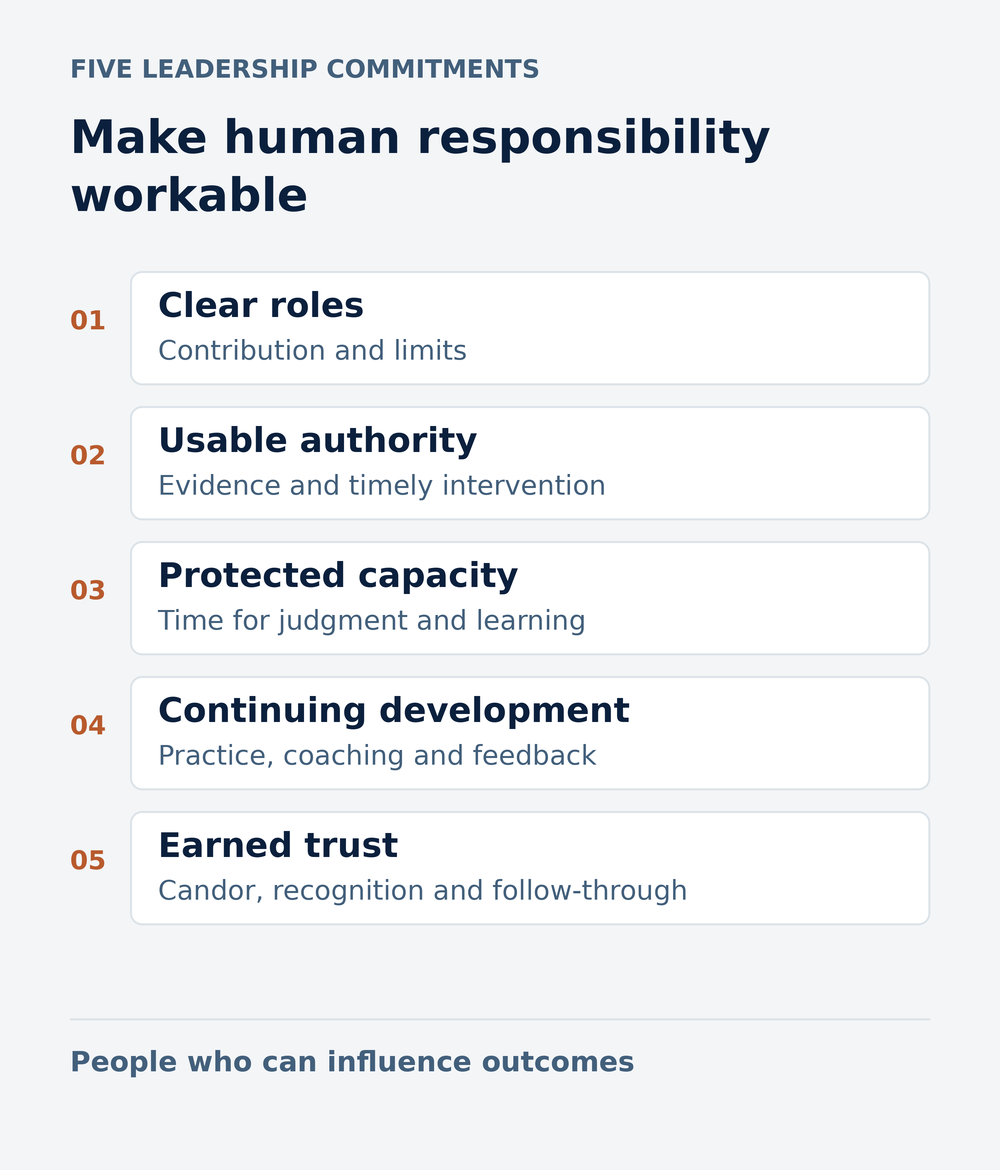
Five commitments support people’s ability to influence outcomes as more work moves into systems.
The approach
Redesign the work that remains
The starting point is the outcome the operation must deliver: timely payment, dependable service, a fair resolution, or continuity when something goes wrong. Then examine how the human contribution to that outcome changes.
If routine cases move into an automated path, the remaining queue may contain a greater concentration of ambiguity, conflicting information, and sensitive conversations. Fewer cases do not necessarily mean a proportionate reduction in workload. Someone must also review patterns, maintain knowledge, coach colleagues, and follow through on recurring problems.
This is where outcome stewardship becomes useful: responsibility for the quality, continuity, and improvement of an operation. It should describe a workable contribution, with clear limits. A frontline employee can be responsible for recognizing and escalating a concern within their remit; the Outcome owner remains responsible for the overall operation and the resources it needs.
Before counting released time as a benefit, decide how it will be used. Some may support additional demand. Some may fund better service, learning, and prevention. Any planned staffing reduction needs to account for the work that remains, including peak demand and system disruption.
Evaluate the new role against its actual mix of work. Keeping yesterday’s transaction target while adding investigation and coaching creates competing expectations. Recognize sound decisions, useful knowledge contributions, and improvements alongside throughput.
Give judgment room to change an outcome
Responsibility becomes credible when a person can obtain relevant evidence and act while the outcome is still changeable. They need to understand the context used, the applicable policy, what is uncertain, and how to reach someone with the authority to resolve the issue.
For actions too fast to interrupt individually, protection must also come from limits and controls established beforehand. An employee cannot compensate for a system design that makes timely intervention impossible.
Human involvement itself offers no automatic performance advantage. A 2024 review of 106 experiments, drawn from studies published between January 2020 and June 2023, found that combined human–AI performance was, on average, better than unaided human performance but below that of whichever performed better alone: the human or the AI. Results varied substantially across tasks and study designs. These experiments do not establish the effectiveness of a particular enterprise oversight arrangement. They do challenge the assumption that adding a reviewer necessarily improves it. Vaccaro, Almaatouq, and Malone’s meta-analysis of human–AI collaboration.
My implication for leaders is to test the contribution of the human role in the actual workflow. Does the person bring missing context, catch consequential errors, resolve conflicting priorities, or improve a decision?
A concern should reach a named responder within a defined time. Where justified, an employee should be able to pause work within an agreed scope. The person raising a concern also needs to hear what happened next. That response makes it worthwhile to keep contributing judgment.
A payment exception makes the choice concrete
Hypothetical example—not a reported engagement or achieved result.
A shared-services team introduces a system that prepares and releases payments within approved limits. Before one payment is released, an operator learns of a possible supplier quality dispute that is absent from the information available to the system.
The concern may be valid, incomplete, or unrelated to the payment obligation. The operator needs a way to verify it and obtain a timely decision. Expecting them either to ignore it or to resolve the commercial issue alone would leave the role poorly defined.
| Part of the work | Existing arrangement in this example | Proposed redesign |
|---|---|---|
| Raising the concern | The operator messages a colleague; the payment continues unless someone intervenes informally. | A recorded, time-limited pause routes the concern to the designated decision-maker before release, where the payment timetable allows. |
| Resolving the case | The operator chases information while carrying the same processing target. | Investigation time is planned; the decision-maker verifies the dispute and payment obligation, records the decision, and responds to the operator. |
| Preventing recurrence | Knowledge of the dispute remains in messages and individual memory. | The Operating owner decides whether an approved knowledge or control change is needed and explains the disposition to the team. |
Illustrative operating choices; no benefits have been measured.
The proposed value is earlier recognition of relevant context, a defensible payment decision, and less repeated chasing. It must be tested against unnecessary holds, payment delays, investigation effort, and recurring exceptions. A lower payment-processing cost would be an incomplete result if it depended on unrecorded human work or avoidable supplier disruption.
Keep building the expertise the operation will need
Role redesign also changes how people learn. When everyday cases provide less hands-on practice, leaders should examine how a new employee will develop the judgment expected of an experienced colleague.
AI can support that development. In a study of 5,172 customer-support workers, published in 2025, access to an AI assistant increased issues resolved per hour by about 15% on average, with larger benefits for less experienced and lower-skilled workers. The researchers also found evidence of learning. The study concerned an assistant in one firm, with employees retaining control of customer conversations; it does not establish equivalent results for autonomous execution. Brynjolfsson, Li, and Raymond, Generative AI at Work.
The practical choice is how to make learning part of the redesigned job. Use selected cases for independent assessment before showing the system’s recommendation. Let experienced colleagues explain why similar-looking cases require different treatment. Rehearse a disruption so the team knows which work can continue, which must pause, and where specialist help is needed.
Protect time for this work and make it available across shifts and levels of experience. Evaluate whether people can identify missing evidence, explain a trade-off, and seek help appropriately. Training completion alone does not demonstrate those abilities.
The AI-Era Workforce Capability framework develops the broader capability model. The issue here is whether the redesigned operation continues to create the expertise on which its future reliability depends.
Make the transition credible to the people doing the work
Leaders should be candid about what is changing. Some tasks may disappear, some roles may shrink, and some new responsibilities may require substantial development. A promise of more meaningful work needs to be backed by actual opportunities, support, and fair criteria for progression.
Where staffing changes are intended, explain what has been decided, what remains uncertain, how decisions will be made, and what transition support is available. People should be able to assess the proposal without having to reconcile an optimistic message with an undisclosed cost target.
Involve employees while work is being redesigned. Ask where the proposed workflow leaves them without enough time, context, discretion, or support. They may identify an unresolved customer need, a dependency on an experienced colleague, or an escalation route that cannot work during an evening shift.
OECD research published in 2023, covering employers and workers in manufacturing and finance across seven countries, found that worker consultation and training were associated with better worker outcomes. This is an association, not proof that consultation caused the improvement. It provides relevant workplace evidence alongside the operating reasons for involving employees. OECD findings from surveys of employers and workers.
That participation should continue after launch. Managers need to distinguish a justified challenge from avoidable rework, acknowledge concerns raised in good faith, and explain why suggested changes were accepted or declined. Employees need evidence that their contribution can improve the work.
Within the Transformation Operating Map, these choices begin in Phase 2, Design the Operating Model, and must hold by Phase 5, Transfer Ownership. From Project Team to Business Ownership covers the handoff mechanics; this article addresses whether people can sustain the responsibilities they inherit.
Leadership takeaway
Can the team demonstrate the role you have designed?
Before expanding autonomy in one workflow, ask an experienced operator, a newer colleague, and the Outcome owner to walk through a consequential exception together.
Have them show what each person would notice, what evidence they could access, what they could change, and who would respond next. Include a case the system fails to flag. Then ask the manager to show where investigation, learning, and follow-up fit into the team’s workload and performance expectations.
Use the exercise to identify one gap that matters to the outcome. Assign an owner to correct it and repeat the exercise before widening delegation.
A credible human role is one the team can demonstrate under ordinary operating pressure. The leadership task is to provide the conditions that make it possible.
Sources and further reading
Evidence cited in this article:
- Michelle Vaccaro, Abdullah Almaatouq, and Thomas Malone. When combinations of humans and AI are useful: A systematic review and meta-analysis. Nature Human Behaviour, October 28, 2024. Covers experiments published between January 2020 and June 2023.
- Erik Brynjolfsson, Danielle Li, and Lindsey Raymond. Generative AI at Work. The Quarterly Journal of Economics, published online February 4, 2025; May 2025 issue. Field evidence from one firm’s customer-support operation.
- Marguerita Lane, Morgan Williams, and Stijn Broecke. The impact of AI on the workplace: Main findings from the OECD AI surveys of employers and workers. OECD Working Paper No. 288, March 27, 2023.