 RePerspective Labs
INSIGHT
Deep Dive
Bounded Autonomy: Governance for the AI Era
How leaders should decide what AI may do, when people must intervene, and what evidence justifies changing the boundary.
Executive summary
Giving AI a business task also requires deciding which consequences it may create. Bounded autonomy makes that delegation explicit: a defined purpose, permitted actions, evidence requirements, escalation conditions, and an Outcome owner. The boundary should reflect the importance of the outcome, the cost of delay, the reach of an error, and the enterprise’s ability to detect and recover from it. Authority must remain conditional on those operating capabilities. Leaders should authorize specific decisions, test the handoffs and human capacity around them, and use evidence to Continue, Narrow or Expand authority as conditions change.
The question
What, exactly, are we authorizing AI to do?
An initiative described as “AI-enabled invoice processing” can include reading a document, identifying a match, resolving a discrepancy, changing a record, and authorizing a payment. Those activities carry different consequences. Approving the initiative does not settle which of them the system may perform independently.
The ambiguity often sits between steps. A status update that looks administrative to one team may trigger a consequential action in another system. A recommendation may become the effective decision if the reviewer lacks time or evidence to challenge it.
For an executive, this creates a specific responsibility: understand where an AI contribution becomes enterprise authority, including across organizational handoffs.
The question is therefore more precise than how much autonomy to allow. Which decisions can this operation responsibly delegate, under what conditions, and what must happen when those conditions fail?
My perspective
I would grant AI authority only where the business can explain the permitted outcome, recognize when the conditions no longer hold, and take responsibility for recovery. That makes autonomy a continuing operating decision. A more capable model widens the possibilities; the organization’s ability to own the consequences determines the boundary.
Shashi Sethi
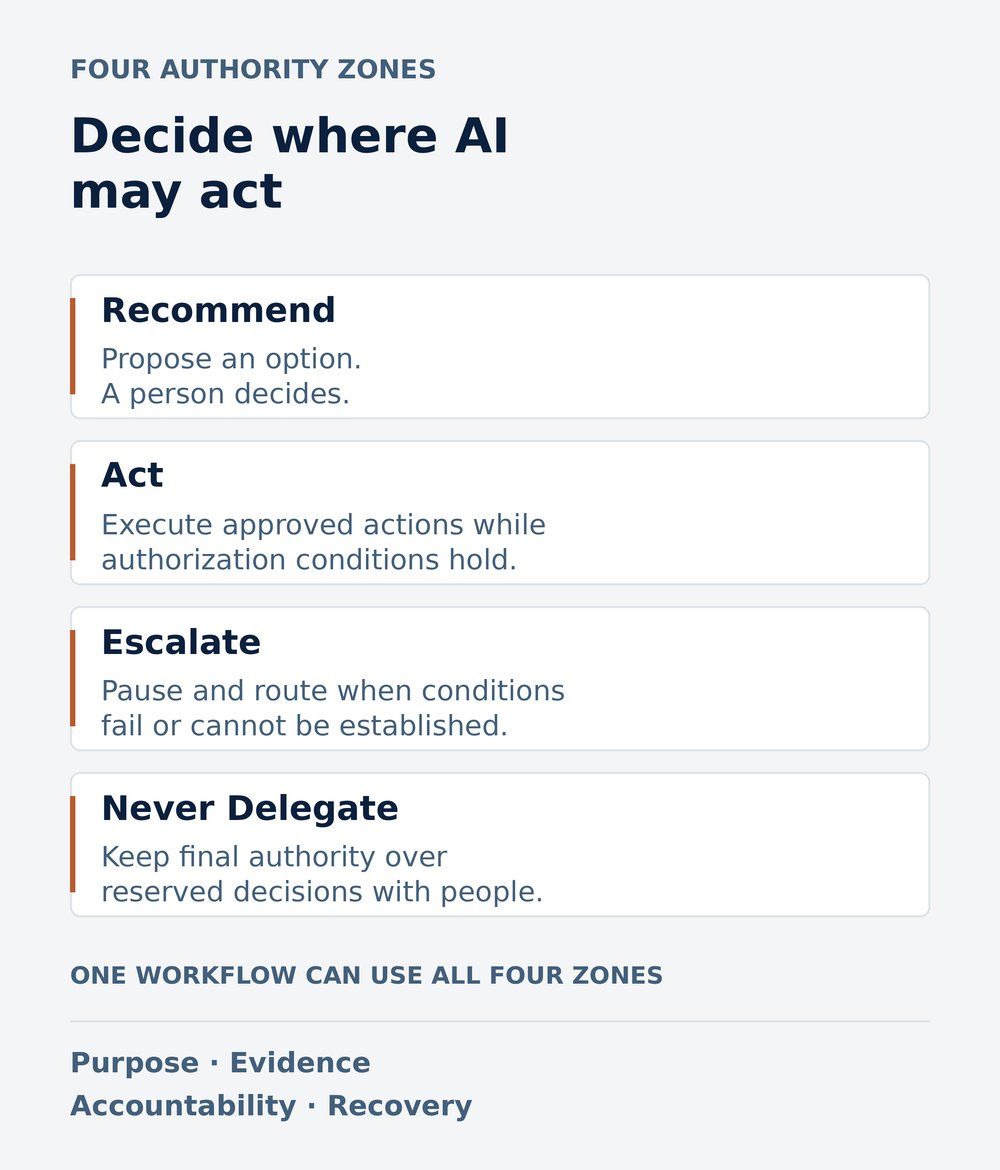
A single workflow can use all four authority zones. Leaders set the conditions for action, human judgment, escalation, and reserved decisions.
The approach
Begin with the outcome and the specific decision
Bounded autonomy means giving an AI-enabled system permission to make specified decisions or take specified actions within an explicitly governed scope.
Start by locating the delay, inconsistency, or missed opportunity in the current operation. Then identify which delegation would improve the outcome. Faster document preparation may deliver the value the business needs without transferring approval authority. Where rules already settle the decision, conventional automation may be sufficient.
A useful delegation describes the action, eligible cases, required evidence, permitted downstream effects, and Outcome owner. “Support accounts payable” describes a function. “Mark an invoice as matched when approved checks pass, while preserving separate payment authorization” describes a boundary.
NIST’s AI Risk Management Framework 1.0, published January 26, 2023, places intended scope, documented responsibilities, human oversight, and executive responsibility for AI risk within the same management structure. These are established governance disciplines to apply to the specific work.
In the Transformation Operating Map, this is primarily Phase 2: Design the Operating Model. The leadership choice is where authority belongs. Controls by Design develops how the agreed limits are enforced during implementation and operation.
Use four authority zones within the same workflow
The existing RePerspective Labs authority model provides a practical vocabulary for that choice.
| Authority zone | What the system may do | What leaders must settle |
|---|---|---|
| Recommend | Assemble evidence and propose an option; a person decides whether the consequential action proceeds. | Who reviews, what evidence they need, and how they can challenge the recommendation. |
| Act | Execute specified actions without approval of each individual case, while all authorization conditions hold. | Eligible cases, permitted consequences, limits, and recovery arrangements. |
| Escalate | Pause the affected action and route the case when a boundary condition fails or cannot be established. | The trigger, receiving team, response time, and fallback if review is unavailable. |
| Never Delegate | Support analysis while final authority over a reserved decision remains human. | Which decisions are reserved and why, regardless of model confidence or routine performance. |
A workflow can use all four zones. Recommend is an advisory role; Escalate is a response to a boundary being reached. Never Delegate identifies authority that remains reserved, such as setting enterprise risk appetite or approving an expansion of the system’s own mandate. The zones do not represent a maturity ladder.
The Bounded Autonomy Framework provides the fuller boundary specification. Here, the task is to justify the allocation of authority.
Set the boundary by consequence, context, and recovery
A boundary needs more than a transaction limit or a confidence score.
Follow the consequences across the whole operation
Assess what an action can cause after it leaves the immediate workflow. Changing a supplier record, issuing a customer commitment, or updating a case status may activate other processes. A small permitted action can therefore create a larger commitment than its owner intended.
The same reasoning applies to volume. A tolerable exposure on one case may become unacceptable when the same error repeats across a batch. Leaders should consider cumulative exposure and how far an error can travel before it is detected.
OWASP’s 2026 guidance on Excessive Agency identifies unnecessary functionality, excessive permissions, and excessive autonomy as sources of risk. It recommends preserving authorization scope across chained actions and enforcing permission checks outside the model’s own judgment.
The operating implication is straightforward: every handoff must preserve the original limit on authority. Connecting another system must not quietly enlarge the mandate.
Judge reversibility in business terms
A database change may be technically reversible after its business consequences have become difficult to repair. Restoring a record does not necessarily recover money, reverse a customer’s decision, or repair a damaged relationship.
Ask how quickly an error would be recognized, who could intervene, and what recovery would require. Where consequences develop faster than people can respond, the necessary protection must operate before the action proceeds. A dashboard reviewed later cannot carry that responsibility.
Delay also has a cost. Requiring approval for every low-consequence action may prolong service queues and consume attention needed for difficult cases. The aim is proportionate delegation that improves the complete service, including its exceptions.
Make authority conditional on usable evidence
A sound decision in a familiar case does not establish reliability in a different population, region, or policy context. Define which evidence must be present and authoritative before the system can act.
Conflicting records, an unverified policy version, or a missing prerequisite should change the permitted response. A model’s expressed confidence cannot substitute for those conditions.
This is where knowledge quality becomes an authority question: if the operation cannot establish the facts required for delegation, it must narrow the action or seek human judgment.
Make the invoice boundary unambiguous
Hypothetical operating example — a proposed design, not a reported implementation or measured result.
Consider a finance operation where analysts spend substantial effort assembling invoice evidence and checking routine matches. The proposed objective is to shorten processing time while preserving payment integrity and capacity for disputed cases.
AI could extract invoice details, assemble the purchase order and receipt evidence, and propose a match. Approved validation rules would check the required records, supplier status, relevant tolerances, and duplicate indicators. The original documents would remain unchanged.
For eligible cases, the workflow could mark the invoice matched and route it into the existing payment-approval process. That status would mean only that the specified matching checks had passed. It would confer no authority to release funds.
A new supplier, changed bank details, a suspected duplicate, missing receipt evidence, or a discrepancy outside the approved tolerance would pause the affected path and send the evidence to a named finance analyst. The AI-enabled workflow would have no permission to change supplier banking details, waive required checks, or release payment.
Keeping payment authorization outside this delegation is a design choice for this example. Another enterprise could set a different boundary after evaluating its obligations, controls, and recovery capability.
The crucial review spans the handoff: if a downstream system treats “matched” as permission to pay, the proposed separation does not hold.
The expected benefit is less routine preparation and faster handling of clean cases. To test it, compare end-to-end processing time, rework, incorrect matches, exception age, payment errors, and analyst workload against the baseline. Include implementation, review, support, and control costs. Time released becomes a realized benefit only when the operation uses that capacity productively.
Give the human boundary enough capacity to work
Escalation transfers work and judgment to people. Its viability therefore depends on staffing, competence, available evidence, and the time within which a decision must be made.
A named reviewer who cannot inspect the case before a service deadline is not a workable fallback. Design the backup owner and continuity response before granting authority. Depending on the operation, that may mean holding the affected action, routing work to a staffed alternative, or temporarily reducing automated intake. A missed response deadline must not silently become approval.
NIST’s Generative AI Profile, published July 26, 2024, identifies over-reliance and automation bias among human–AI interaction risks. Human presence alone does not establish effective scrutiny.
My judgment is that review capacity belongs in the delegation decision and its economics. If the business case assumes most reviewers disappear while the operating model depends on their timely intervention, the two designs are incompatible.
People also need authority to challenge an apparently successful result and report a flawed boundary without being treated as an obstacle to adoption. Evaluate whether their interventions improve outcomes. An incentive to approve quickly can undermine the judgment the boundary depends on.
Review the authority as conditions change
A delegation should identify the evidence that would justify retaining, narrowing, or expanding it.
A higher completion rate does not answer that question by itself. It may reflect better performance, easier cases, or fewer exceptions being detected. Examine decision quality and downstream outcomes alongside the amount of work completed automatically.
Before expansion, test the proposed scope under representative conditions, including difficult cases and loss of required data or human availability. Review whether the operation can detect problems, contain their effects, and recover within its commitments.
NIST’s AI RMF, MANAGE 2.4, calls for mechanisms and assigned responsibilities to supersede, disengage, or deactivate systems whose performance or outcomes diverge from intended use. Withdrawal of authority belongs in the original design.
Assign the right to change the boundary explicitly. The Outcome owner should propose scope changes, with risk, control, and technology owners supplying the relevant challenge and evidence. The designated approving authority decides whether to expand the mandate. Operators should have a separate, predefined right to pause affected work within the incident procedure.
A change in policy, knowledge source, system permissions, case mix, or service conditions should trigger review where it affects the basis of authorization. The system may support that review; it should not authorize its own expansion.
Narrowing authority can preserve value when conditions deteriorate. The useful measure of maturity is how reliably the enterprise makes and revisits these decisions.
Leadership takeaway
Test the delegation before expanding it
Choose one AI-enabled workflow approaching scale. Ask its Outcome owner, frontline operator, and Control lead to walk through three cases together: an ordinary case, a case that crosses a boundary, and a case in which the expected reviewer is unavailable.
For each, trace the permitted action into the next system. Identify who decides, which evidence they see, how long the operation can wait, and how it continues if the normal path fails.
Record the specific authority being granted, the conditions that would suspend it, and who may restore or expand it. Resolve any disagreement before increasing scope.
Then review whether the design improves the business outcome after exception handling and oversight costs are included. The delegation is ready when the people inheriting the operation can demonstrate how they will keep it within its mandate.
Sources and further reading
- NIST — Artificial Intelligence Risk Management Framework (AI RMF 1.0). January 26, 2023. Relevant sections: GOVERN 2, MAP 3, MEASURE 2, and MANAGE 2.4. Supports scope, accountability, oversight, evaluation, and withdrawal of authority.
- NIST — Artificial Intelligence Risk Management Framework: Generative Artificial Intelligence Profile. July 26, 2024. Section 2.7 addresses human–AI configuration, including over-reliance and automation bias.
- OWASP GenAI Security Project — LLM03:2026 Excessive Agency, in the OWASP GenAI LLM Top 10 2026. August 2026. Supports limiting permissions, preserving authority across handoffs, and checking authorization independently of model judgment.
These sources support specific governance and security considerations. The argument about sustainable delegation, the four-zone application, and the invoice design are RePerspective Labs’ editorial synthesis and proposed operating choices.