 RePerspective Labs
INSIGHT
Founder's Perspective
Working with AI When the Problem Is Still Taking Shape
Begin with a purpose, discover the questions that matter, and let evidence shape the next step.
Executive summary
A useful AI conversation can begin before a problem is fully defined. Start with an outcome, let AI propose a manageable set of connected questions, and choose the help each question needs. Some knowledge can be applied and checked; some gaps require research; some experience needs to be drawn out; and some possibilities need exploration. As evidence develops, revise the questions and their relationships. Leaders should make this a working discipline: identify whose knowledge is needed, preserve uncertainty, and agree what would justify the next commitment. The result should be a clearer decision and a testable next step, with ownership intact.
The question
How do you begin when you cannot yet describe the whole problem?
A leader wants smoother project handoffs. The team sees repeated chasing, late changes, and missing context, but cannot yet separate the causes. It is unclear whether the next move should address readiness criteria, records, responsibilities, or something else.
Asking AI for a complete solution at this point may produce a polished plan built around assumptions nobody has examined. Waiting until every dependency is understood can leave the team with little help getting started.
There is useful work between those positions: developing the problem together. An AI assistant can propose questions and organize what is learned; people supply operating context, challenge the framing, and decide what deserves investigation. The leadership question is how to make that conversation progressively more informative—and recognize when it supports a practical next step.
My perspective
I would start with the outcome and the uncertainty we can already name. Let AI help develop the questions, then bring the right people and evidence into the conversation. The value is in how our understanding changes: a useful discovery should sharpen the next question, expose a dependency, or change the action we are prepared to take.
Shashi Sethi
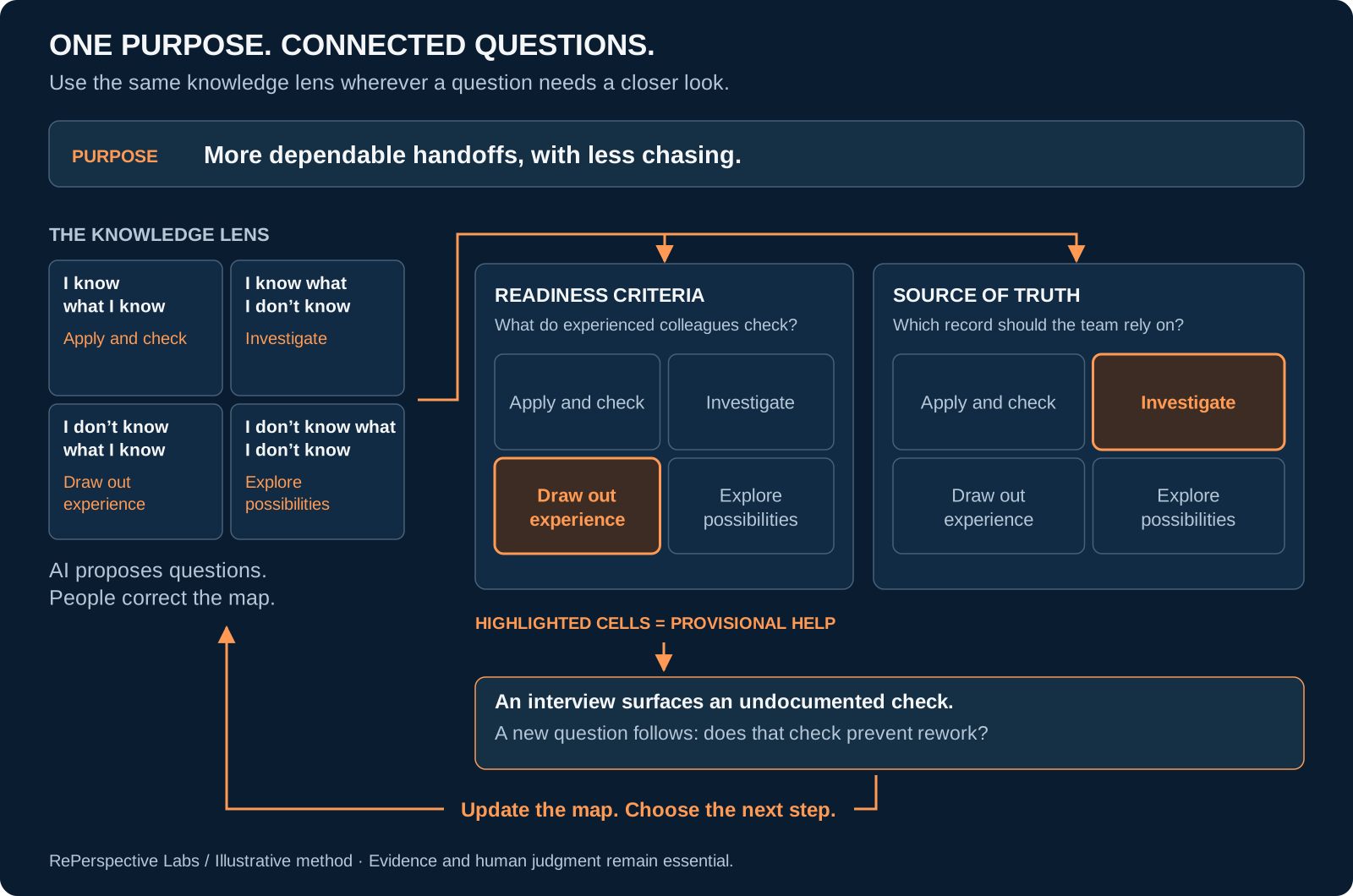
Illustrative application of the same knowledge lens to connected questions. Highlighted cells show provisional kinds of help, not verified diagnoses. A finding can create a new question, change another branch, or reshape the next step. No permission to act is implied.
The approach
Begin with a purpose you can explain
A starting description needs enough context to orient the conversation: the outcome sought, the people affected, and the constraints already known. “We spend too much time chasing project updates and want more dependable handoffs” is enough to begin exploring. It does not yet establish the cause or prescribe the solution.
Consider an everyday illustration: planning a vacation. You may know your dates and budget, need to investigate local driving requirements, and have preferences you only articulate when someone asks about past trips. Discussing one destination may reveal a transport dependency that changes which hotel makes sense. Different parts of the same plan need different kinds of help.
The same principle can guide an enterprise conversation. When the destination itself feels constrained by current routines, use Possibilities to explore a different outcome. Select a question worth pursuing, then examine the conditions that would make it feasible.
Choose the help that fits the question
The familiar language of knowns and unknowns offers a useful starting lens. The distinction among known knowns, known unknowns, and unknown unknowns predates current AI tools and appeared in Donald Rumsfeld’s February 2002 briefing. [1] Here, a fourth state—knowledge or experience not yet articulated—is included to help shape the conversation.
The following mapping is RePerspective Labs’ proposed working aid. It is not a validated assessment of someone’s knowledge, a maturity model, or an automatic assignment of work to AI.
| Starting state | Useful help | What to establish |
|---|---|---|
| I know what I know | Apply and check. Organize established information, compare options, or prepare a draft. | Which evidence supports it, and does it apply here? |
| I know what I don’t know | Investigate. Clarify the missing fact or relationship and seek an appropriate source. | Who or what can answer, and how will the answer be checked? |
| I don’t know what I know | Draw out experience. Ask about examples, habits, exceptions, and unstated assumptions. | What can be articulated and tested with the people who do the work? |
| I don’t know what I don’t know | Explore possibilities. Suggest alternative perspectives and potentially missing considerations. | Which suggestions warrant investigation? Coverage remains incomplete. |
The third state is shorthand for experience that has not yet been made explicit in this discussion. It can also point toward knowledge held elsewhere in the organization, although another person’s knowledge is not literally your own. Ask whose perspective is represented before labeling a gap.
Apply the lens to a specific question or assumption. An entire initiative will usually contain several kinds of uncertainty. A statement initially treated as known may need investigation when its source or applicability is challenged.
Let AI propose the map—and keep it open to correction
Letting AI suggest the first breakdown can reduce the preparation needed to begin. Ask for a small set of connected questions and the assumptions behind them. Review that map before expanding it. A missing stakeholder, an incorrect boundary, or a premature solution can shape every branch that follows.
There is research behind using decomposition in AI interactions. Zhou and colleagues’ least-to-most prompting study examined breaking problems into simpler subproblems and using earlier answers in subsequent steps. Its experiments concerned specified reasoning tasks; they do not validate an enterprise discovery method or establish that an AI-generated map is complete. [2]
In practical use, the map should distinguish what someone reported, what a source supports, what has been inferred, and what remains unresolved. The distinction matters because a plausible explanation may still be incorrect. NIST’s Generative AI Profile identifies confidently erroneous content as a characteristic risk. [3] A claim should move toward “established” through suitable evidence, not merely because the assistant repeats it convincingly.
People should challenge the proposed framing early. AI can help formulate an interview question; it cannot substitute for the colleague whose experience is missing. Some questions will be resolved through a record, a conversation, or a small observation without further AI help. Nor does understanding a task grant permission to execute it. Authority remains a separate operating decision.
Follow the connections as understanding changes
Illustrative enterprise scenario. A team wants to reduce handoff delays while keeping consequential decisions with people. It begins with an impression that information is scattered. The cause has not been established.
An initial conversation might produce four connected questions:
- Outcome: What makes a handoff useful to the receiving team, and where does the current delay begin and end?
- Readiness: What do experienced colleagues check before accepting the work?
- Records: Where are the latest decision, its reasoning, and any changed dependencies recorded—and which source is authoritative?
- Exceptions: What situations would require a person to reconsider an otherwise routine handoff?
Suppose an interview reveals that an experienced coordinator checks for an unresolved dependency before treating an item as ready. That check was absent from the initial description. Drawing out experience has now created an investigation: how often is this dependency missing, and does it explain delays?
The team examines a defined sample of recent handoffs. Imagine that the sample suggests people use different meanings of “ready,” even when the relevant records are available. The next action changes: agree and test the readiness criteria with both teams before investing in another summary or integration.
If the evidence instead points to inaccessible or inconsistent records, knowledge access becomes the priority. Both paths remain hypotheses until checked. Their value is that a finding in one branch changes what happens elsewhere.
The method therefore needs a return path. Update the shared picture after a useful discovery. Merge duplicate questions, retire assumptions that no longer hold, and record which dependency changed the proposed action. Repeated smaller assessments should improve the whole decision.
The AI Puzzle explains the wider discipline of connecting operating capabilities. This Insight addresses the earlier discovery work: how to develop that picture while the questions themselves are still emerging.
Stop when the next commitment can be judged
Discovery needs a useful stopping point. Agree the decision and the time available before branching further. Continue exploring when an unresolved question could materially change the outcome, feasibility, or acceptability of the next step.
Pause the conversation when the team can describe one bounded action, identify who owns it, name the remaining uncertainty, and specify the evidence that would support proceeding, revising, or stopping. The strength of evidence should match the consequences of that commitment.
For the handoff example, an initial trial might compare elapsed handoff time, the share accepted without clarification, and total preparation and review effort against a baseline for comparable work. Check omissions and rework as well as speed. These are proposed tests, not promised results. Measurement provides further measures to adapt to the operating outcome, including first-time-right completion and human oversight effort.
When a question becomes a design decision about knowledge, coordination, or authority, use the Autonomy Map to examine those connections. It can help locate the next operating question; choosing to retain human approval can remain an appropriate outcome.
Try the conversation with a starter prompt
Paste the prompt below into your preferred AI assistant. Use an approved tool and share only material appropriate for it. You can start with a rough description; the prompt does not require a completed business case or a starting quadrant.
It is self-contained and does not require access to this website. It guides the conversation; it cannot ensure that the assistant will follow every instruction or produce reliable conclusions. Review what it proposes.
Help me work through a situation that is still taking shape. My aim is a clearer understanding and a practical next step.

Start by asking what I want to improve, for whom, and in what context, unless I have already told you. I can begin with a rough description or say “not sure.”

After that first answer:

1. Propose a small, provisional map of the main questions and dependencies. Base it on what I share. Label assumptions and invite me to correct the map before developing it further.

2. Use four kinds of help as appropriate: apply and check established knowledge; investigate a recognized gap; ask questions that draw out experience or unstated assumptions; explore alternative perspectives and possible missing considerations. You do not need to use all four. Do not claim to know everything I know or to have discovered every blind spot.

3. Ask one question at a time. Offer a few tailored options plus Other, Not sure, and Skip. When a choice calls for judgment, give a tentative recommendation and explain why. Let me combine options or answer freely. Wait for my reply.

4. Keep my statements, source-supported facts, your inferences, and unresolved questions distinguishable. Cite sources you actually accessed and flag what you cannot verify. Ask whose knowledge or which record could help. Do not treat a fluent answer, a confident label, or my agreement as verification.

5. When an answer reveals a dependency, examine it only if it could change the outcome, feasibility, or next decision. Explain which other question it affects. Update the map when evidence changes it; do not keep expanding branches without a reason.

6. After roughly five answers, or earlier if enough is clear, summarize the current purpose, what we have learned, the most important uncertainty, and one practical next action. Identify who should be involved, what evidence to gather, and what would lead us to proceed, revise, or stop. Ask whether to investigate further or close with that next step.

Keep this exercise to discussion, research, and preparation. Do not send messages, change records, or commit resources without my separate authorization.
If you want the conversation explicitly grounded in RePerspective Labs’ operating dimensions, the Autonomy Map’s “Use this map with your AI” section provides its own guide-based starter. Use whichever starting point suits the work; neither requires you to know every question in advance.
Leadership takeaway
Make the next decision clearer
Choose one unresolved operating issue and ask a small group to explore it with AI. Include someone who receives the work, someone who understands the exceptions, and a person accountable for the next decision. Give the discussion a time boundary and ask it to produce one evidence-gathering action.
Review the conversation by what changed: a corrected assumption, a newly visible dependency, a colleague whose knowledge is needed, or a better-defined test. A larger map is useful only when it improves the decision.
The leadership test is straightforward: can the team explain what it now understands, what remains uncertain, and why the next step is justified? That is a practical basis for building confidence while the problem is still taking shape.
Sources and further reading
- U.S. Department of Defense briefing, February 12, 2002, reproduced in the Department of State Washington File archive. Historical source for the three-part known/unknown distinction. It does not establish the four-state AI interaction method proposed here.
- Denny Zhou and colleagues, Least-to-Most Prompting Enables Complex Reasoning in Large Language Models. First submitted May 21, 2022; revised April 16, 2023; ICLR 2023. Evidence about decomposition on the study’s reasoning tasks, with no claim of validation for this enterprise method.
- NIST, Artificial Intelligence Risk Management Framework: Generative Artificial Intelligence Profile, NIST AI 600-1. July 26, 2024, especially section 2.2 on confabulation. Supports distinguishing model-generated explanations from evidence.
The four-state interaction mapping, connected-question illustration, enterprise scenario, suggested measures, and starter prompt are RePerspective Labs’ editorial synthesis and proposed practice. The scenario is hypothetical; no measured benefit or external validation of this method is claimed.