 RePerspective Labs
INSIGHT
Deep Dive
The Knowledge Backbone for Intelligent Enterprises
Trusted knowledge becomes an operating capability when people and systems can establish what applies, who owns it, and how it changes.
Executive summary
An intelligent enterprise needs a dependable way to establish which knowledge applies to a decision, who stands behind it, and what happens when it changes. Searchable content alone cannot provide that assurance. This article argues for treating the knowledge backbone as an operating capability: Knowledge owners define authority and applicability; people and systems receive usable context; and approved corrections reach the workflows that depend on them. Leaders should begin with a consequential decision, fund continuing knowledge stewardship, and test whether the arrangement improves outcomes. Wider autonomy should depend partly on the quality and continuity of that evidence.
The question
What makes enterprise knowledge fit to act on?
When leaders approve an AI capability, they also approve a dependency on the information that will shape its responses. That dependency deserves the same attention as the workflow the capability is expected to improve.
A useful document can still be unsuitable for a particular decision. It may describe another product, apply to a different period, omit an exception, or explain customary practice without authorizing it. Bringing such material into a fluent answer can make those distinctions harder for a busy employee to see.
Experienced colleagues can help interpret the gaps. Their judgment is valuable, but an operation that relies on finding the right person each time has a continuity problem.
The executive question is therefore specific: how will the enterprise establish what people and systems may rely on at the point of work—and keep that assurance dependable as conditions change?
My perspective
I would make the decision the unit of knowledge investment. The enterprise must be able to explain what people and systems may rely on for that decision, under which conditions, and who can change it. If that assurance breaks, the permitted response must change too. Owning a knowledge backbone means maintaining that relationship as the business evolves.
Shashi Sethi
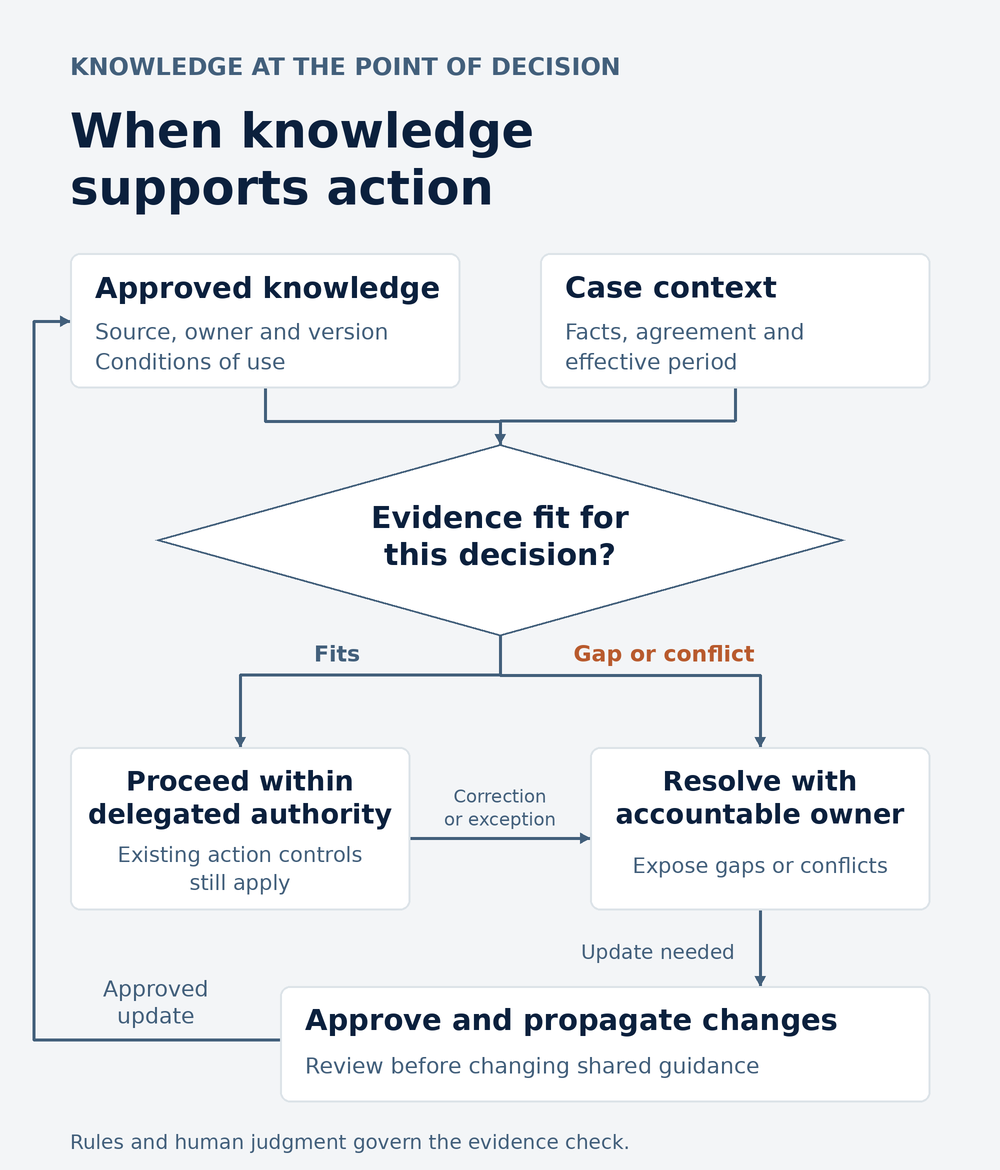
Knowledge supports action when evidence fits the decision. Gaps return to accountable owners, and approved changes reach dependent workflows.
The approach
Start with the decision that needs support
Begin with an operating outcome: more consistent customer resolutions, fewer avoidable exceptions, or faster onboarding without weakening judgment. Then identify the decisions that determine that outcome and the knowledge each requires.
This changes the scope of the work. A broad instruction to connect company documents reveals little about whether a service representative can resolve a case correctly. A defined decision exposes the necessary policy, customer facts, contractual terms, exception guidance, and authority to proceed.
It also clarifies the relationship between data and knowledge. The data estate holds records, documents, events, and other source material. Operational knowledge adds their meaning and conditions of use: what a status signifies, which rule applies, why an exception exists, and who has approved it. A knowledge backbone connects that material and meaning to the work that depends on them.
Shared definitions matter here. If two functions use “resolved” differently, linking their systems does not settle the disagreement. The business must establish the meaning needed for the decision, including legitimate differences between contexts.
This is a focused extension of the Enterprise Knowledge Backbone framework. The framework describes the supporting capabilities. The leadership choice here is where to establish dependable knowledge first, and what responsibility accompanies using it.
Make the conditions for use explicit
For a consequential decision, I would expect the operation to answer five questions.
These are conditions the business should define and the operating system should enforce. A relevance score or a convincing explanation cannot establish them on its own.
Retrieval-augmented generation supplies source material to a model when it prepares a response. It can still produce statements that the supplied material does not support. The August 2024 RAGTruth study documents this problem in responses generated by the systems it examined. Its findings support a specific distinction: retrieving evidence and using that evidence faithfully are separate things to evaluate.
NIST’s July 2024 Generative AI Profile similarly recommends checking output sources and citations before deployment and during ongoing monitoring, and verifying the grounding of retrieval data.
My operating implication is that knowledge checks must affect behavior. Missing evidence may permit a preliminary explanation while preventing a commitment to a customer. Conflicting guidance may require an Knowledge owner to resolve it. The response should follow the consequence of being wrong and the authority already delegated.
A sound knowledge backbone strengthens this arrangement. Model evaluation, access controls, and controls over actions remain necessary.
A refund decision shows why freshness is not enough
Hypothetical example—not a reported engagement or measured result.
Consider a business service team using an assistant to prepare refund recommendations. Its objective is consistent customer treatment with less time spent reconstructing the applicable terms. Employees retain authority to approve refunds within existing limits.
The standard service policy has recently changed. A particular customer’s older agreement contains a different refund provision. For this example, assume the organization’s approved precedence rules give that provision priority for this case.
An assistant that always chooses the newest policy could give an incorrect recommendation while citing an authentic, current document. The missing capability is establishing applicability.
In the proposed arrangement, the workflow brings together the customer agreement, relevant service dates, case facts, and approved precedence guidance. The employee can inspect the governing provision and understand why it applies. If the agreement cannot be located or its interpretation is disputed, the workflow requests resolution from the designated commercial owner before making a customer commitment.
The older agreement remains usable for the cases it governs. It should be clearly distinguished from material that has genuinely been superseded.
If the commercial owner approves a one-off exception, the record should preserve its scope and rationale. That decision does not automatically become a rule for every customer.
The expected benefits are fewer inconsistent recommendations and less rework. They would need to be demonstrated through reviewed cases, including conflicting guidance and missing information, while accounting for the time employees spend resolving exceptions.
Treat a knowledge change as a change to operations
Once several workflows depend on the same knowledge, changing it becomes an operational event. The owner needs to know which processes, assistants, rules, and human guidance depend on the affected source.
That dependency should shape the release. An urgent correction may require the affected action to pause until reliable guidance is available. A routine revision may allow a planned transition. Both need a clear effective point and a way to verify that dependent work has adopted the change.
A policy update is complete when the affected work uses it correctly.
This requires attention to copies and derived material: summaries, search indexes, local procedures, and embedded rules can all continue carrying an earlier interpretation. Retiring a source from current use also requires preserving the appropriate history so a prior decision can be reviewed against the material that governed it.
The practical test is to replay representative decisions after a change, including cases that should continue using older terms. Check the evidence selected and the resulting behavior. If a shared source turns out to be wrong, the same dependency information should help identify which workflows and decisions need review.
Shared knowledge creates opportunities for reuse. It also creates shared exposure when an error propagates. Investment in the backbone must cover both.
Give expertise an accountable route into the system
People contribute more than corrections to documents. They explain why a rule exists, recognize where the documented process misses operating reality, and distinguish a justified exception from a workaround that should end.
Capturing that contribution takes time and trust. Employees need an easy way to challenge guidance, visibility into how the issue was resolved, and time within their role to help maintain the knowledge they use. Asking for contributions while measuring only transaction throughput sends an inconsistent message.
The review must preserve the difference between observation, interpretation, and approved guidance. An AI-generated summary of past decisions may help identify a pattern. It should enter a review process before influencing future decisions as authoritative knowledge.
Some judgment will remain difficult to codify. The backbone should make that boundary visible and help the next person reach the appropriate expertise with the necessary context.
Feedback becomes useful organizational learning when an owner evaluates it, approves an appropriate change, and checks its effect in subsequent work.
Fund the capability through a bounded operating problem
I would start with one consequential decision in a defined workflow and extend the backbone as evidence supports it. That creates a manageable scope for agreeing definitions, testing source applicability, and understanding the cost of keeping knowledge dependable.
A federated arrangement is a reasonable starting design: domain owners maintain the meaning and authority of their knowledge, while shared services provide access, versioning, dependency tracking, and evaluation support. Material can remain in appropriate systems of record. Common standards make it usable across those systems.
That arrangement needs explicit responsibilities. The Knowledge owner approves meaning, applicability, and precedence. Technology owners maintain reliable delivery and technical enforcement. An accountable operating owner resolves issues that cross domains and funds the continuing service.
The budget should cover stewardship, employee contribution time, maintenance, evaluation, and exception handling. Funding only the initial connection leaves the conditions for trust without an operating owner or capacity.
Measure whether the chosen workflow becomes more dependable: how often reviewed decisions use applicable evidence, how quickly approved corrections reach dependent work, how much rework comes from knowledge gaps, and whether employees can resolve cases with appropriate support. Compare these with a baseline and the full cost of the capability. Time released represents capacity until the business demonstrates how it has been used.
In the Transformation Operating Map, this work belongs primarily in Build the Intelligence Layer, sustained through Improve Continuously. Expansion should follow demonstrated operating value and maintainable ownership.
Leadership takeaway
Test one decision before extending autonomy
At the next review of an AI-enabled workflow, ask the team to bring one consequential decision, the evidence used, and the person accountable for that evidence.
Then change one condition: revise the policy, introduce an older agreement that still applies, or make a required source unavailable. Observe whether the operation selects the right knowledge, exposes the gap, and changes its permitted response.
Use what happens to decide the next investment. If the evidence is dependable but interpretation fails, investigate the model and application. If applicability or ownership is unresolved, address that dependency. If a correction never reaches the workflow, repair the change process.
Extend autonomy only where the knowledge, interpretation, controls, and ownership have earned that decision. A successful demonstration should reveal what the enterprise can sustain—and what still needs work.
Sources and further reading
- Cheng Niu and colleagues, “RAGTruth: A Hallucination Corpus for Developing Trustworthy Retrieval-Augmented Language Models.” Association for Computational Linguistics, August 2024. Primary research supporting the distinction between retrieval and faithful use of evidence; it does not measure the performance of every current system. Read the paper and abstract.
- National Institute of Standards and Technology, “Artificial Intelligence Risk Management Framework: Generative Artificial Intelligence Profile,” NIST AI 600-1. July 2024. Suggested actions MS-2.5-003 and MS-2.5-005 address source verification and grounding. This guidance supports those practices; it does not validate the article’s proposed operating design or benefits. Read the profile.
These are supporting sources used in the article. The decision focus, ownership arrangement, investment choices, and hypothetical example express RePerspective Labs’ proposed operating approach.