 RePerspective Labs
Founder's Perspective
AI Strategy: The Leadership Approach to a New Operating Model
Five leadership commitments from Envision to Improve
Executive summary
AI strategy connects what an enterprise wants to become with the capabilities, investment, and operating choices required to get there. Leaders must identify worthwhile problems and opportunities, assess their starting point, and reconcile commitments across business functions. Envision, Plan, Build, Operate, and Improve provide a practical discipline for doing that. Each connects ambition to execution, with people, governance, economics, and resilience considered throughout. The objective is a business capability that creates value, can be sustained, and improves as the organization learns.
The question
The question that exposes the gap
Ask someone working on an AI initiative what the organization is trying to achieve. Sometimes the answer is a version of “My boss wants it.”
That answer deserves an executive's attention. Someone may understand the task and the technology while remaining unclear about the business purpose, the future they are helping create, or how success will be judged. Teams then make local choices without a shared direction, and employees are asked to trust changes whose implications remain unexplained.
Agents, integration protocols, and model capabilities deserve informed discussion. The leadership conversation must establish which outcomes matter, whose work should change, and what the enterprise is prepared to sustain.
My perspective
My view is that AI strategy becomes executable when leaders connect a clear enterprise ambition to consistent commitments about investment, people, authority, and operating responsibility. Evidence must then inform how those commitments evolve.
Shashi Sethi
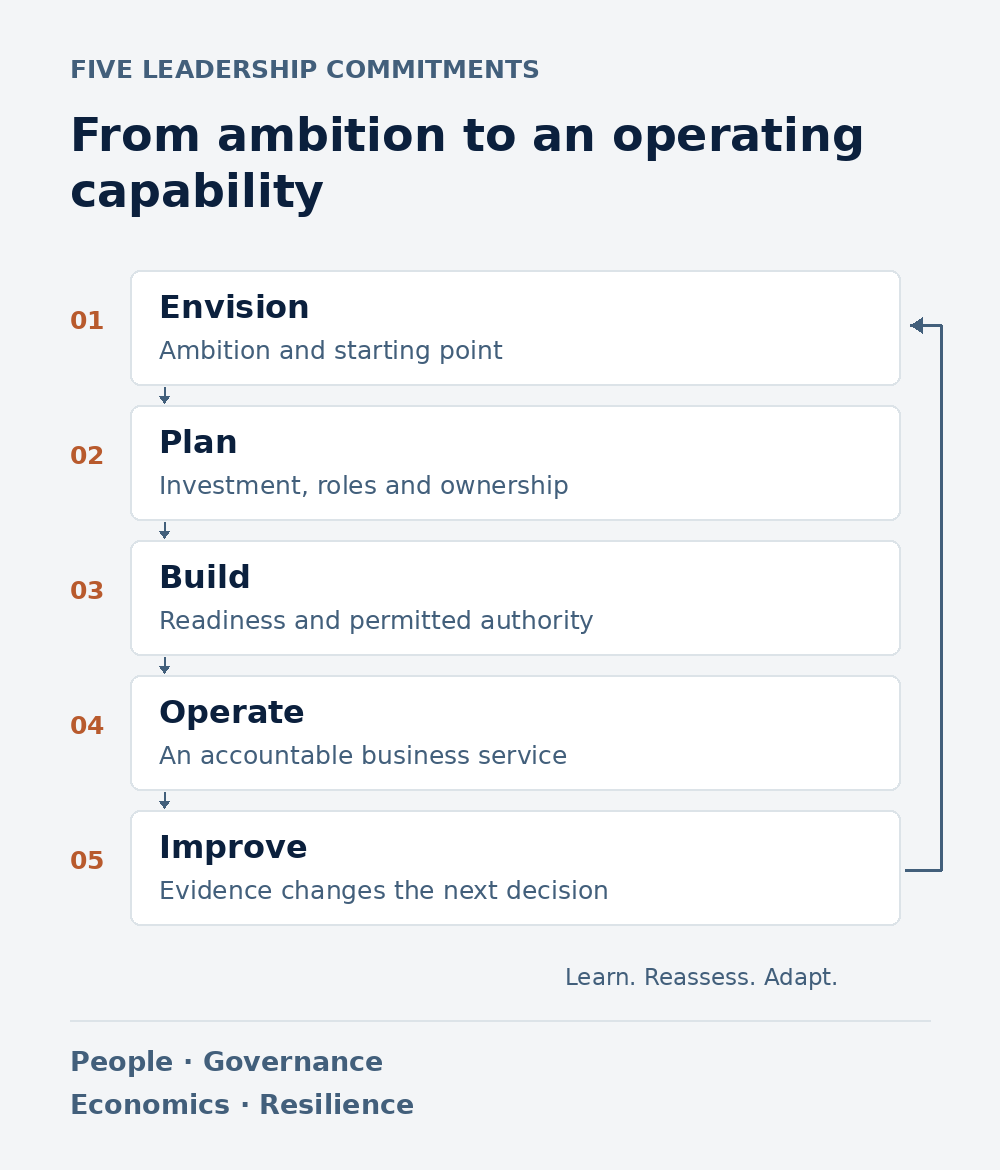
Five leadership commitments connect ambition to execution. Evidence feeds back into earlier decisions, with people, governance, economics, and resilience considered throughout.
The approach
What AI changes about the leadership task
Enterprise automation already required process redesign, governance, integration, ownership, and change management. AI builds on those disciplines and creates additional demands where systems interpret ambiguous information or select actions across workflows.
With generative AI, plausible output can be incorrect, and quality can vary across tasks and contexts. That variation is distinct from drift: changes in inputs, business conditions, knowledge, or system versions can alter performance over time. Leaders need evidence about both the range of behavior and whether previously accepted performance continues to hold. NIST's generative AI profile identifies limitations in transferring laboratory and benchmark results to real-world use. NIST, Generative Artificial Intelligence Profile.
When AI systems can act, deployment also involves decisions about delegated authority: what they may do, under which conditions, and who can intervene. Technical capability and operating design must be evaluated together.
The current adoption picture makes these questions consequential. McKinsey's August 2026 survey reports that 80% of respondents saw improved individual productivity from AI, while 37% attributed at least some enterprise EBIT impact to it, a share broadly unchanged from the previous survey. Among respondents from companies with more than $1 billion in annual revenue, the share reporting agent scaling rose from 27% to 40%. These self-reported measures do not establish why enterprise impact remains uneven. They show why wider use needs to be assessed alongside business results. McKinsey, The state of AI in 2026.
Faster analysis can leave an approval bottleneck untouched. Time released in one team can become review work in another. Token consumption is a usage and cost input; it does not establish the full cost or business value of a capability.
Leadership must understand how improvements become better service, stronger decisions, capacity for growth, or a commercially valuable new offering.
Five commitments that connect direction to execution
Envision, Plan, Build, Operate, and Improve describe a continuing leadership discipline. Their value comes from the decisions each makes explicit and the feedback between them. Operational learning can reopen the plan or change the destination. People, funding, governance, and resilience influence every commitment.
| Phase | Leadership commitment | Executive question |
|---|---|---|
| Envision | Establish the ambition and understand the starting point. | What value should we create, and what capability would it require? |
| Plan | Align investment, roles, dependencies, and ownership. | Can the commitments behind the roadmap coexist? |
| Build | Establish readiness and permitted authority through evidence. | Can the technology, workflow, and people perform within the agreed boundaries? |
| Operate | Sustain an accountable business service. | Can we maintain outcomes when conditions change or the AI is wrong or unavailable? |
| Improve | Let evidence change priorities and investment. | What should we strengthen, redesign, expand, or retire? |
Consider a multi-site enterprise preparing for growth. It has an ERP, invoice capture, and approval workflows, yet supplier invoices stall because purchase orders, service confirmations, contract terms, and correspondence sit across different teams and systems. Accounts Payable repeatedly chases Procurement and local Operations for context.
Illustrative hypothesis. This fictional scenario describes a proposed operating design and benefits to test. It does not report an implementation or achieved results.
The hypothesis is that connecting knowledge, workflow, ownership, and appropriate AI assistance could improve payment reliability and support growth without a proportional increase in administrative effort. The leadership choices behind that proposition run through all five phases.
Envision: establish the destination and assess what it requires
My starting point is two questions: where are we, and where do we want to go?
The destination should emerge from three connected considerations. The problem: which constraints or unmet needs matter, and has technology advanced enough to make a better solution feasible? The opportunity: what could the enterprise now offer or accomplish? The alignment: how does this support its direction, and is the opportunity significant enough to reconsider that direction?
The opportunity deserves as much attention as the problem. AI might make a service economical for customers the enterprise could not previously serve, support a different customer promise, or enable a new revenue model. Leaders must test whether customers value that difference, whether the economics work, and whether pursuing it deserves priority over other investments.
In the supplier scenario, the ambition is dependable operations that can absorb growth. Assessment should identify what that requires, what exists, what is missing, and what remains unproven. Examine actual work, informal coordination, data access, controls, and employee expertise. Existing capabilities are assets to assess and reuse.
People doing the work, affected stakeholders, and the leaders controlling relevant resources should help shape this assessment. A destination becomes more credible when its implications are understood early.
The assessment and ambition should inform each other. Poor service-confirmation practices might justify an initial process improvement. Better access to trusted context might make broader coordination feasible. That learning should refine the roadmap while keeping the enterprise's longer-term options visible.
Plan: reconcile the commitments behind the roadmap
Suppose Finance expects near-term payroll savings, Operations expects capacity for growth, and HR has told employees that released time will support development. Those expectations may require different decisions about staffing, workload, and investment. The executive sponsor must reconcile them before they become competing instructions to the delivery team.
A practical leadership review places the intended outcome, funding assumptions, workforce commitments, control boundaries, and service obligations side by side. For each conflict, record the decision owner, evidence needed, and decision date. The operating case establishes the investment and operating logic; this review tests whether the commitments across functions are compatible.
The business leader owns the outcome. Finance challenges the economics. Technology and architecture leaders address integration and dependencies. Operations and HR shape roles, staffing, and capability. Risk, security, legal, and compliance contribute according to exposure. Management retains responsibility for processes and controls; Internal Audit provides independent assurance and advice. This distinction is consistent with the IIA's Three Lines Model, updated in July 2026. IIA, Three Lines Model.
Use an executive forum with authority to resolve cross-functional choices. Specify which decisions teams can make locally, and escalate conflicts that require changed resources, obligations, or risk acceptance.
Funding should make CAPEX and OPEX implications visible under the organization's accounting policies and cover the full capability lifecycle: integration, knowledge maintenance, evaluation, training, controls, support, recovery, and improvement. Shared capabilities need an enterprise funding owner and a benefits record that prevents double counting.
In the supplier scenario, Accounts Payable might fund an assistant while local Operations lacks capacity to improve service confirmations. The sponsor must fund that upstream work, narrow the ambition, or accept a constraint on the expected benefit.
Build, buy, and partner choices belong in the same conversation. Decide which capabilities provide differentiation and which can be obtained reliably from others. Assess supplier practices, data access, contractual obligations, service dependencies, and the practical ability to replace a provider as economics or requirements change.
Workforce commitments need equal clarity. What work will change? What judgment will people exercise? Will they have time to learn and authority to question a recommendation? Address concerns about job security, surveillance, and professional standing directly. Where decisions remain open, explain how and when they will be made.
OECD's 2023 surveys in manufacturing and finance across seven countries found worker consultation and training associated with better worker outcomes. That supports taking participation seriously, while leaving causation and applicability to a specific initiative open. OECD, The impact of AI on the workplace.
The roadmap should then sequence bounded increments, each with an outcome, accountable owner, capability dependencies, evidence requirement, and decision to expand, revise, or stop.
Build: establish readiness and authority through evidence
A demonstration establishes possibility. Readiness requires evidence about the complete workflow, including incomplete information, incorrect outputs, and difficult exceptions.
Start the supplier scenario with assistance: assemble source-linked context and propose next steps while qualified people retain the relevant decisions. Test representative invoice types and supplier variations. Use permissions and workflow controls to enforce action boundaries; a model's expression of confidence cannot grant authority.
An assistant might assemble order history and correspondence for an invoice missing service confirmation. An authorized person must still establish whether the service was received. A plausible explanation cannot become proof. Payment authorization and supplier bank-detail changes remain separately controlled.
Build workforce capability alongside the technical capability. Employees need practice checking source evidence, recognizing limits, handling exceptions, and escalating concerns. Assess whether they can perform the redesigned work under realistic conditions. OECD's June 2026 skills brief emphasizes data interpretation, managerial capability, and human skills alongside technical proficiency. OECD, AI and skills: What we know so far.
Compare handling effort, quality, elapsed resolution time, and control exceptions against a baseline, accounting for case mix and workload. Include effort across all participating teams. A shorter AI processing step can be offset by additional checking or correction.
Employees' feedback should inform the next increment. Adoption targets must leave room to report poor recommendations and increased burden. Expand scope or authority when evidence supports doing so; assistance may remain the appropriate operating choice.
Operate: sustain the service and the commitments to people
Operations should influence design from the outset. Before deployment, demonstrate that ownership, support, controls, and recovery work. Name the business process owner early and transfer responsibilities with the capability, time, resources, and authority to exercise them.
Establish who maintains knowledge, investigates failures, supports users, authorizes changes, and communicates during disruption. Observability should connect technical behavior to business consequences: stalled cases, rejected recommendations, rising rework, and payment obligations at risk. Each signal needs an accountable response.
Business continuity must account for fallback capacity. If the assistant is unavailable, can employees manage the remaining work, prioritize critical obligations, and reconcile case status afterward? A manual procedure that nobody can staff remains an untested assumption. NIST includes feedback, overrides, incident response, recovery, change management, and decommissioning within continuing post-deployment responsibilities. NIST, Generative Artificial Intelligence Profile.
Review the human consequences alongside service performance. Has repetitive chasing decreased? Has review burden risen? Do people have time to exercise judgment and confidence that raising concerns leads to action? Trust depends partly on whether staffing, workload, and performance decisions match leadership's stated commitments.
Evaluate the full cost of acceptable outcomes, including review, rework, support, and exceptions. Released time creates business value through an explicit use: absorbing demand, improving service, redeploying capability, or avoiding expenditure. Recognize cash savings when the financial effect can be demonstrated.
Improve: let evidence change the next decision
Improvement should address the conditions creating work as well as the technology handling it. If missing confirmations drive recurring invoice exceptions, the next intervention may be clearer receipt responsibilities or better supplier guidance. A more capable model cannot settle an unresolved business obligation.
The process owner should review outcomes with Finance, Technology, affected teams, and relevant control functions. Ask whether the hypothesis holds, where burdens have moved, and which assumptions have changed. Validate changes to knowledge, workflows, models, and permissions before expanding their use.
At enterprise level, compare shared-capability investments with local improvements. Revisit opportunities previously constrained by cost or capability. Redirect resources when evidence weakens a case, and retire capabilities whose value no longer justifies their cost or exposure. Plan the transition for the service and the people affected.
The supplier hypothesis can be assessed through the following changes. The future state remains a proposal until operating evidence supports it.
| AS IS: assumed current state | TO BE: proposed operating design | Evidence to seek |
|---|---|---|
| Employees repeatedly gather missing context. | AI assembles source-linked context; people verify unresolved facts. | Lower handling effort and rework across participating teams. |
| Exceptions move between functional queues. | A process owner coordinates named exception owners. | Shorter resolution times, fewer aged exceptions, more valid invoices paid by their due dates. |
| Experienced staff compensate for undocumented knowledge. | Maintained guidance, practice, and redesigned roles support judgment. | Fewer repeated clarifications; demonstrated handling of difficult cases; manageable review burden. |
| Disruption leaves case status and responsibility unclear. | Retained case state, backup ownership, and tested recovery support continuity. | Critical obligations maintained; recovery and backlog within agreed limits. |
| Closing an invoice ends the work. | Recurring exceptions inform approved upstream changes. | Fewer repeat exceptions and sustained service improvement. |
The intended value is capacity for growth, dependable supplier relationships, clearer accountability, and work people can perform with less coordination burden. These are outcomes to measure before making claims about savings or scale.
Leadership takeaway
The leadership test
At the next executive review, choose one AI initiative. Ask the sponsor, Finance, an operational manager, and someone doing the work to describe its purpose, intended value, and implications for people. Compare those answers with the funding, roadmap, and measures.
Where they disagree, resolve the leadership choice. Where they agree, test whether resources and evidence support the commitments. This exercise can reveal contradictions that a maturity score alone may conceal.
Within the RePerspective Labs Transformation Operating Map, this perspective centers on Design the Operating Model, connecting opportunity framing to building, deployment, explicit ownership transfer, and continuous improvement.
My view is that durable AI strategy requires leaders to hold enterprise ambition and operating reality together, then adjust their choices as they learn. The people doing the work should be able to explain what the organization is becoming, why it matters, and how their contribution moves it there.
Sources and further reading
McKinsey — The state of AI in 2026: On the road to ROI. 25 August 2026.
NIST — Artificial Intelligence Risk Management Framework: Generative Artificial Intelligence Profile. July 2024.
Institute of Internal Auditors — Three Lines Model: Assurance and Advice in Support of Effective Governance. 8 July 2026.
OECD — The impact of AI on the workplace: Main findings from the OECD AI surveys of employers and workers. 27 March 2023.
OECD — AI and skills: What we know so far. 5 June 2026.