 RePerspective Labs
INSIGHT
Founder's Perspective
Fund the Operating Model Behind AI Value
Allocate funding and scarce people across immediate improvements, shared capabilities and broader operating change.
Executive summary
Leaders should fund connected operating commitments against a common service objective, budget and capacity limit. A local improvement may deserve priority when it addresses a pressing service gap; a shared capability earns funding through specific dependent uses; broader change may warrant a bounded trial. The decision must include continuing maintenance, transition effort and the people who can actually do the work. In the hypothetical insurance portfolio below, new maintenance evidence changes the mix without increasing total spending. Continuing the local capability requires a fresh comparison of future benefits, avoidable costs and displaced work, even when its reported cost rises.
The question
Which combination deserves funding now
Three proposals can each have a credible business case and still make an undeliverable portfolio. They may depend on the same policy experts, assume the same shared service will be available, or claim the same released hours. Approving them separately leaves someone else to resolve the collision during delivery.
The executive question is which combination can improve the operation within the money, expertise and transition capacity available now. That requires a choice about value: which service result matters enough to fund, which enabling obligations it brings, and which promising work should wait.
The Value Lens helps identify worthwhile problems and alternatives. The operating business case tests an individual commitment. Portfolio allocation connects those commitments and makes their competing demands explicit.
My perspective
I would give priority to a bounded improvement that closes a meaningful service gap and can be supported reliably. I would also fund the shared obligations it creates and preserve a proportionate way to learn about broader change. A portfolio earns confidence when leaders can explain both the selected combination and what would cause them to change it.
Shashi Sethi
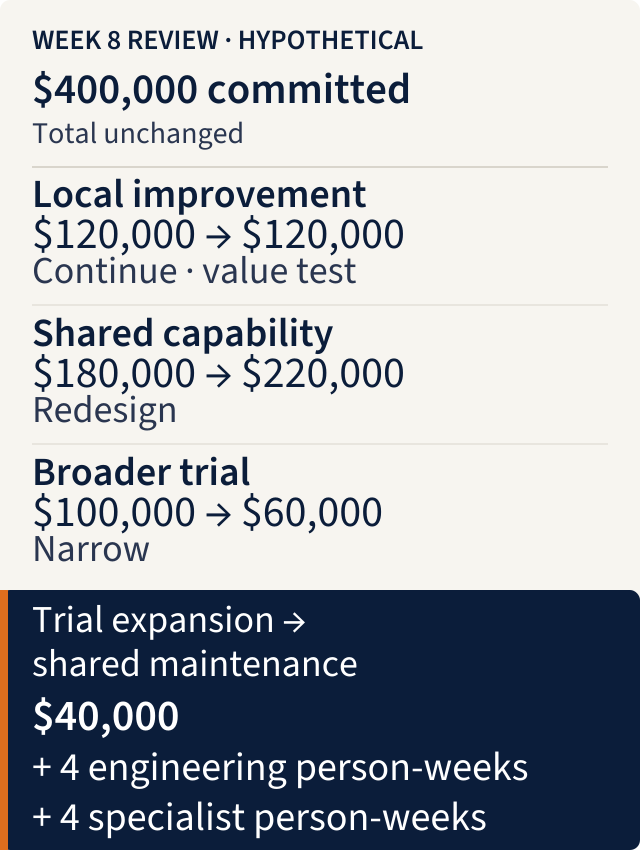
Hypothetical 26-week portfolio. At week 8, the transfer from trial expansion to shared maintenance is $40,000 + 4 engineering person-weeks + 4 specialist person-weeks. Daily operations stay protected. Detailed costs, capacity and the local continuation test appear below.
The approach
Protect the operation before allocating change
Start with the service that must continue: today’s customer work, required controls, incident response and maintenance of existing capabilities. Ring-fence that funding and staffing before asking how much change the organization can absorb. A portfolio that borrows essential operating capacity has understated its cost and risk.
Then compare complete commitments over the same period. Include build and transition effort, the recurring service obligation, dependencies and the expertise required at particular times. The UK government’s project-delivery standard treats portfolio choices as a balance of objectives, funding and resource capacity, with plans revised when those constraints change. That is a useful management reference here, rather than a requirement imposed on a private insurer.[1]
Choose the service result and the combination
The following insurer, costs, observations and decisions are entirely hypothetical. All portfolio costs cover one 26-week period and include assigned internal labor and other costs once. They are resource costs, not all incremental cash payments. Recurring amounts cover this period only; they are not annual run rates.
An insurer wants evidence-ready claims to reach authorized handlers sooner. Its local team handles 200 eligible first submissions a week in one product and complexity band. The Outcome owner accepts a file when required evidence is present, material information is correct and the receiving handler can proceed without avoidable clarification. This is acceptance of a prepared file. Coverage and settlement decisions remain with authorized humans.
The local service commitment
Measure all eligible submissions, including exceptions and failures. Compare like case mixes and follow each weekly cohort for ten business days to catch returns and correction work. The baseline covers four preceding weeks, or 800 submissions. The local pilot starts in week 3 using existing controlled tools; cohorts from weeks 3–6 complete follow-up by the week 8 review. Quality is checked in a 200-file audit sample in each comparison period; the small sample supports continued scrutiny, not a claim of proven safety.
The local proposal combines existing rules-based completeness checks with AI-assisted evidence preparation. A simpler change to controlled guidance and existing rules remains the alternative. In this illustration, a preliminary test of that alternative reaches 82% timely acceptance and 12% returns, short of the agreed service target.
The shared proposal maintains evidence requirements, controlled source access and evaluation for two named uses: the local capability and a broader claims trial. The full operating change would redesign intake, evidence gathering, handoffs and exception work. Its potential value is larger but less established, with greater transition demands.
Competing commitments and the initial funding choice
Costs in $000. Cost entries show one-time + recurring = total. E / S means engineering / business-specialist person-weeks for the full 26 weeks.
The authorized portfolio ceiling is $500,000. Essential operations retain their separate existing budget. Across the relevant staffing pools, 104 engineering and 52 business-specialist person-weeks are available in the period; 64 and 32 are protected for established services, maintenance and continuity. That leaves 40 engineering and 20 specialist weeks. The latter are named change assignments from two authorized claims-policy experts. These are net schedulable assignments, with leave and other commitments already allowed for.
The full requests need 56 engineering and 30 specialist weeks as well as $600,000. The selected $400,000 combination uses 36 and 20. It leaves $100,000 and four engineering weeks unassigned, but no specialist capacity.
Leaders choose this combination because the local service gap is pressing, the simpler alternative misses the target, and the shared scope is necessary for two committed uses. The $100,000 trial buys evidence about the next bottleneck without committing to full rollout. Its test is whether changing the intake-to-handler handoff reduces elapsed time beyond the local gain without shifting exception work downstream. A trial that cannot answer that question would not deserve funding. Speculative future users do not strengthen the shared-service case. Full rollout waits.
Fund the continuing obligations and name their owners
The shared-services leader is the Outcome owner for the shared capability and its service commitment. The claims director is the Outcome owner for claims results, including the local improvement and trial. The claims manager, as Operating owner, supplies learning time, supervisory attention, exception handling and temporary parallel operation within the approved effort. Line budgets include that transition work; E/S tables track only the constrained engineering and policy-expert pools.
The Knowledge owner maintains claims policy and evidence requirements; the Technology owner maintains access, integration and recovery; the Control lead specifies control evidence and challenges whether requirements are met. The Control lead does not automatically become the risk acceptor or independent assurance provider. Finance challenges assumptions and validates cost and benefit treatment. The COO, as Sponsor, secures cross-team funding and staffing decisions within delegated authority. Claims accountability alone does not authorize the director to commandeer shared staff.
These are the resourced commitments developed in Who Owns the AI-Enabled Operating Model?. Here they determine what can be funded together. The shared agreement names supported uses and service hours, reserved capacity, source-change response, evaluation, support, fallback and renewal. The period’s recurring provision includes review, correction, exceptions and recovery. Future renewal must fund continued maintenance or controlled retirement. NIST’s AI RMF Playbook likewise includes monitoring, change management, recovery and decommissioning within post-deployment management.[2]
Use new evidence to change the allocation
At the end of week 8, the local pilot meets the service targets on the observed cohorts. But source-change rehearsals reveal additional work: keeping the local evidence requirements current will require $40,000 more recurring maintenance and evaluation, plus four engineering and four specialist weeks, during the remaining period.
The constrained specialists are the two claims-policy experts who validate evidence requirements and expected results for exception cases. Generic reviewers or engineers cannot substitute for that judgment. The trial has consumed only two of its eight reserved specialist weeks. Leaders can narrow its unstarted expansion work while retaining one handoff test and its evaluation.
Capacity at the week 8 review
Person-weeks shown as E / S. Consumed effort cannot be released. Remaining figures cover weeks 9–26.
After consumed effort, 22 engineering and 12 specialist weeks remain available to this portfolio; the revised commitments need 18 and 12. The four released specialist weeks are already reserved in eight half-week blocks for the same experts in weeks 9, 11, 13, 15, 17, 19, 21 and 23. Those blocks move from trial expansion to the eight scheduled source-maintenance and evaluation cycles. Four engineering weeks move in the same windows. The receiving and releasing managers confirm the calendar assignments; no daily-operations staffing is borrowed.
The unused $100,000 cannot supply qualified judgment before the first cycle in week 9. There is no available internal substitute; the assumed procurement, domain onboarding and authorization lead time for an external specialist is at least twelve weeks from this review and itself needs incumbent expert time. Later hiring may help a later commitment. It cannot make this period’s early obligations feasible.
The revised portfolio retains the same total commitment
Costs in $000. E / S covers the full 26 weeks, including consumed effort.
The trial releases $30,000 of uncommitted one-time work and $10,000 of avoidable recurring work. Its revised $50,000 one-time amount still includes $20,000 already incurred. The resulting $40,000 funds maintenance. Total spending remains $400,000, but recurring obligations rise from $110,000 to $140,000. The formal decisions are Redesign for the shared maintenance commitment and Narrow for the trial. The local capability’s Continue decision still needs a value test.
Separate shared-cost reporting from the next decision
Initially, the $180,000 shared baseline is attributed equally to the two reserved service commitments: $90,000 to the local capability and $90,000 to the trial. Equal reservation, rather than transaction volume, is the agreed basis. FinOps guidance recognizes fixed, proportional and proxy-based shared-cost allocation; the useful choice depends on what the allocation is intended to explain.[3]
Narrowing the trial leaves its baseline allocation intact because it retains the same minimum controlled access, isolated evaluation and support reservation through week 26. Of the $180,000 baseline, $90,000 is already incurred and $90,000 remains in fixed or non-cancellable period obligations. Those remaining obligations are still needed by the retained uses and cannot be avoided by this narrowing. They are future commitments, not sunk expenditure. The trial’s released $40,000 comes from separate, uncommitted scope.
The additional $40,000 shared maintenance requirement is caused by the local workload and is attributed entirely to it.
Attributed costs reconcile to the consolidated portfolio
Costs in $000. These views replace the central shared-cost line; they are never added to it.
The $250,000 figure makes the local capability’s complete attributed commitment visible. It does not establish what continuing or stopping can change. For the next decision, remove incurred costs from the choice, identify avoidable future obligations, and count any alternative use of resources. The Green Book makes this distinction between sunk costs and the opportunity cost of resources already paid for.[4]
At renewal, review both the shared service’s scope and its allocation. A baseline that cannot be reduced this period may become avoidable next period. A retained reporting share is neither a reason to continue an unsuccessful use nor a reason to deny a valuable one.
Require the higher cost to earn its place
In this hypothetical review, the local pilot’s four weekly cohorts total 800 submissions: 720 are accepted within two business days and 64 are returned for missing evidence, versus 560 and 160 in the matched baseline. Follow-up is complete, sampled material errors remain at 2%, and the receiving manager confirms no increase in effort or aged backlog and no unauthorized decisions. The result supports the service case; the sample does not establish durable performance across every policy change.
The forward choice is specific. Of the local capability’s $120,000 direct cost, $96,000 has been incurred; $24,000 remains avoidable. Continuing also requires the new $40,000 maintenance provision. Its avoidable cost to go is therefore $64,000. Returning to the protected existing process with the tested guidance-and-rules improvement would instead cost an assumed $10,000 for withdrawal, transition and its additional period support. The committed shared baseline is the same under either choice this period. The $10,000 belongs only to the alternative, not the revised $400,000 portfolio.
Use that stronger alternative’s 82% timely acceptance and 12% returns as the forward comparator. At 200 submissions a week, the sixteen cohorts from weeks 9–24 can complete follow-up within the period. Sustaining 90% and 8% would produce 256 additional timely accepted files and 128 fewer missing-evidence returns across those 3,200 submissions. These measures overlap and must not be added. No benefit from the last two immature cohorts is included in this comparison, although the cost provision covers all eighteen remaining weeks. Continuing costs $54,000 more than the alternative and uses specialist time otherwise available for trial expansion. Leaders judge that closing the remaining service gap deserves priority over that additional learning, while retaining the narrower trial’s core question.
Continue is justified only if the Outcome owner accepts that prospective trade-off, the maintenance work keeps the service at or above its target through changing source requirements, and actual recurring effort stays within the revised provision. Review mature cohorts after each change cycle; a quality failure or rising receiving workload requires immediate intervention. If the target cannot be sustained, consider Narrow, Redesign or Stop for the affected capability. Expand requires separate evidence and capacity approval.
Benefits stay with their outcomes. The claims director owns the local service improvement. The broader trial must demonstrate additional handoff value beyond it. The shared service enables both and does not claim the same claims benefit again. Released handling hours must be assigned once to a named use; they are not automatically payroll savings. Future reuse and adaptability remain prospective benefits. The operating business case provides the separate discipline for following capacity into accepted outcomes and realized financial value.
Leadership takeaway
At the next portfolio review, ask for the smallest combination of commitments that can deliver the priority service result, including the obligations that keep it dependable. Make the rejected or deferred alternatives visible, together with the scarce expertise each option consumes.
When evidence changes, distinguish the full attributed cost from the future costs and resource uses the decision can change. Keep daily operations protected, confirm that released people are available when needed, and assign every benefit to one accountable outcome.
Then record the commitment under review and the decision: Expand, Continue, Narrow, Redesign or Stop. Set the next evidence requirement and secure the authority to move money and people. That is how a funded portfolio remains capable of changing direction while still delivering the results it has promised.
Sources and further reading
[1] UK Government Project Delivery — Government Functional Standard GovS 002: Project delivery. Published September 1, 2025; modified March 29, 2026. Sections 5.1, 5.3 and 7.4 support portfolio balance, review and resource-capacity discipline. A public-sector management reference, not an insurance requirement.
[2] NIST AI Resource Center — AI RMF Playbook — Manage. Maintained web guidance accompanying AI RMF 1.0, released January 26, 2023. MANAGE 4.1 supports post-deployment monitoring, change management, recovery and decommissioning. Voluntary guidance; it does not validate this example’s costs or results.
[3] FinOps Foundation — Allocation — FinOps Framework Capability. Maintained web guidance; no fixed publication date shown. Supports choosing an explicit shared-cost allocation approach, including fixed, proportional and proxy methods. The equal reservations in this article are a hypothetical management choice.
[4] HM Treasury — The Green Book 2026. Updated February 5, 2026. Chapter 6, Sunk costs, distinguishes incurred expenditure from the costs and benefits of future decisions and the alternative use of resources. Its public-appraisal scope is distinct from the insurer illustration.