 RePerspective Labs
INSIGHT
Founder's Perspective
The First 100 Days: Build a Roadmap the Operation Can Deliver
Reconcile promises, protect essential services and use early evidence to decide what happens next.
Executive summary
The first 100 days should produce commitments the operation can sustain and a clear basis for revising them. Start with the existing service, a priority outcome and the assets worth reusing. Reconcile financial expectations, customer obligations, workforce promises and delivery dates before they compete for the same capacity. Use discovery to resolve uncertainties, bounded experiments to test operating assumptions and committed delivery to establish a supported service. An illustrative insurance roadmap shows why encouraging results can still require a change in sequence. At day 100, continuation depends on mature service evidence, quality, receiving workload, recurring effort and the Outcome owner’s acceptance of the remaining trade-off.
The question
What can the operation actually commit to?
An executive can inherit several plausible promises: improve customer service, release capacity, reduce cost, support employees through change and deliver a broader AI-enabled operation. The difficulty appears when those promises depend on the same people, knowledge and operating time.
A roadmap becomes credible when it resolves that competition. A useful early improvement may reveal maintenance work that displaces the next initiative. A promised saving may depend on capacity that operations needs elsewhere. A date may survive in a presentation after the people needed to meet it have moved.
AI Strategy: The Leadership Approach to a New Operating Model establishes the leadership commitments. The question here is how to sequence them: what should leaders learn, reconcile and commit during the first 100 days, and what evidence should make them change direction?
My perspective
I would judge the first 100 days by whether leaders can explain what the operation will deliver, who has accepted the obligation and which competing promise has changed. Early improvements matter when their continuing demands are understood. A credible roadmap gives people room to learn while making the next commitment specific enough to execute.
Shashi Sethi
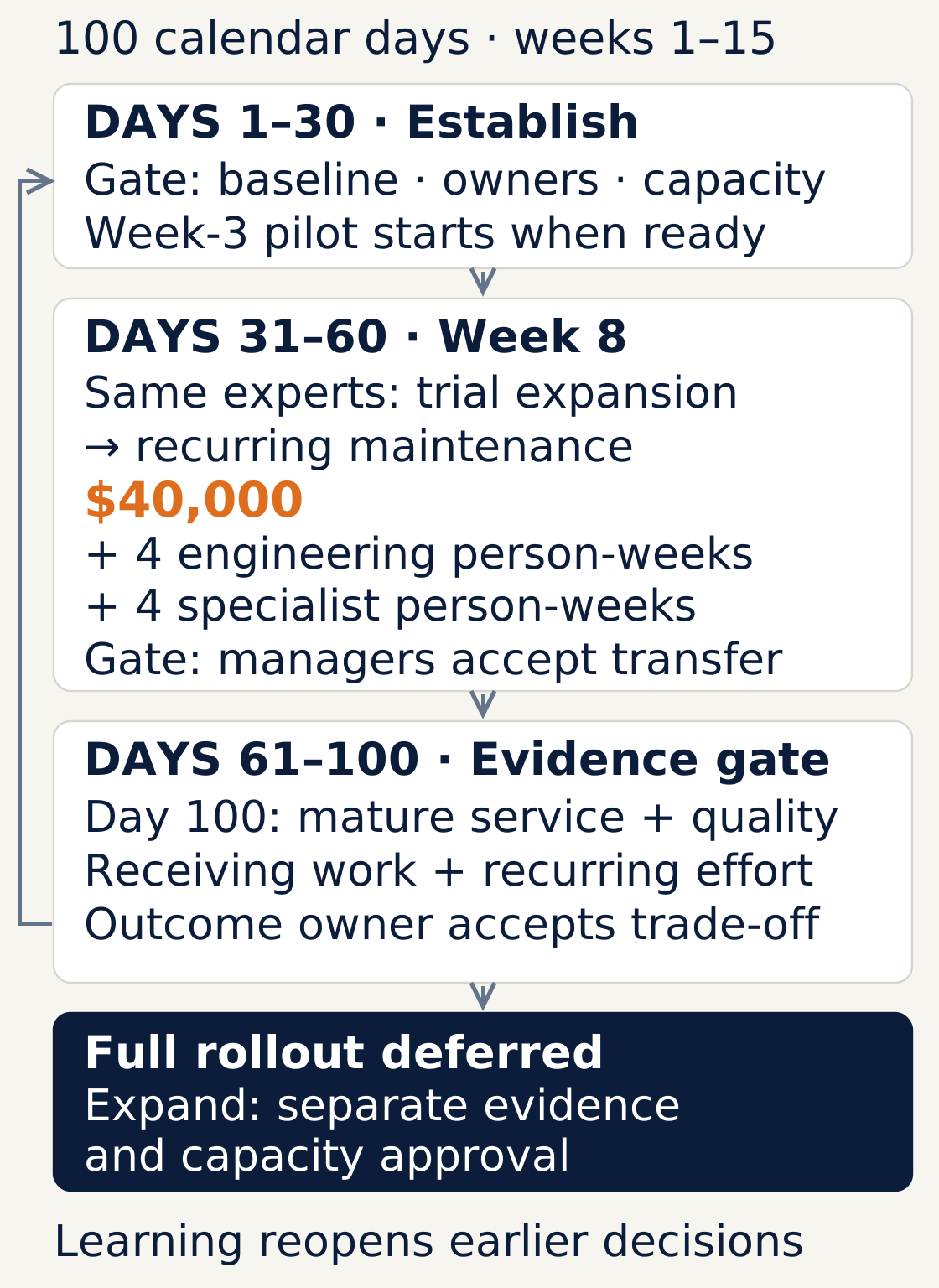
Illustrative roadmap within a 26-week funding period. At week 8, the same scarce experts move from unstarted trial expansion to recurring maintenance. Evidence and capacity authorize commitments; calendar dates and completed maintenance cycles do not authorize expansion. The companion table records the detailed obligations.
The approach
Put the 100 days inside the operating commitment
The insurer in Fund the Operating Model Behind AI Value provides a useful continuation. The organization, costs, observations and decisions are entirely hypothetical. Its 26-week portfolio combines a local claims improvement, a shared knowledge capability and discovery with a bounded trial of a broader claims change. Essential operations retain their separate budget and staffing. The selected $400,000 allocation sits within a $500,000 ceiling, but uses all available claims-policy specialist capacity.
The immediate outcome is a correctly prepared, evidence-ready file that an authorized receiving handler can accept without avoidable clarification. The local scope remains 200 eligible first submissions a week in one product and complexity band; coverage and settlement decisions remain human. The future capability is a dependable way to maintain evidence requirements and improve claims handoffs across the two named uses, with clear ownership and controlled change.
Here, day 1 is the first day of week 1 of that funding period. The window covers 100 calendar days, placing day 100 in week 15, which spans days 99–105. For the illustrative follow-up calendar, weeks start on Monday and business days run Monday–Friday without holidays. The three planning windows overlap work already authorized: the local pilot starts in week 3, the portfolio review occurs in week 8, and funding still covers 26 weeks. A window ending does not authorize progression.
Days 1–30 Establish the starting operation and reconcile its promises
Start with the existing four-week baseline, not a new technology selection. Across 800 eligible submissions, 70% of files were accepted within two business days and 20% were returned for missing evidence. Material errors appeared in 2% of a 200-file audit sample. The agreed target is at least 90% timely acceptance and no more than 8% returns, without increased material errors, receiving effort, aged backlog or unauthorized decisions. Every weekly cohort receives ten business days of follow-up.
Assess what can support that result now. The insurer can reuse controlled guidance, existing systems and access controls, rules-based completeness checks, claims knowledge and experienced handlers. AI-assisted preparation adds to those assets. A tested guidance-and-rules alternative reaches 82% timely acceptance and 12% returns; it remains the fallback and the relevant forward comparator. Reuse reduces the initial change, while named owners establish what must be maintained.
Add one explicit assumption to the earlier example: the opening leadership expectations have not yet been reconciled. Finance expects payroll savings from released handling time; Operations expects better service; the workforce plan reserves learning and redeployment time; and the broader trial has an anticipated expansion date. These expectations cannot all consume the same hours.
The COO, as Sponsor, resolves the cross-team conflict within delegated authority. The claims director remains the Outcome owner. Finance removes unsupported payroll savings from the committed benefit case. The expansion date becomes conditional on evidence and capacity. Customer obligations and essential service levels remain protected; any proposed change to an actual obligation needs its proper authorization. The claims manager, as Operating owner, confirms the learning and transition time in existing line budgets. The revised promises are communicated to the teams expected to deliver them.
Reserve named people in real calendar windows for discovery, delivery, learning, support, exceptions and recovery. Existing service demand, leave and other commitments must already be allowed for. A monetary contingency does not create another qualified policy expert. Who Owns the AI-Enabled Operating Model? supplies the mandate discipline: the claims director cannot commandeer shared staff simply because the claims result depends on them.
Discovery, experiments and delivery buy different things. Discovery funds an answer to a consequential question, with a question-specific time and spending limit; its evidence is a tested problem, constraint or alternative. A bounded experiment receives a separate release for a defined workflow, exposure and evaluation, including failed cases, receiving effort and recovery. Committed delivery funds an accepted service scope, its build work and its continuing operation. Discovery and experiment releases fit inside the approved trial allocation; they do not create extra funding or an automatic right to roll out.
The first window’s exit evidence is an agreed outcome and baseline, an asset-reuse choice, reconciled commitments and funded reservations accepted by their owners. The local pilot can start in week 3 because its prerequisites are satisfied. Questions about the broader handoff can remain in discovery. UK government project-delivery guidance supports this combination of progressive planning, explicit dependencies and resource constraints; it does not prescribe a 100-day timetable for an insurer.[1]
Days 31–60 Let the dependency change the sequence
At the week-8 review, the pilot’s weeks 3–6 cohorts have completed follow-up. Of 800 submissions, 720 were accepted within two business days and 64 were returned for missing evidence. Sampled material errors remain at 2%; receiving effort and aged backlog have not increased, and no unauthorized decisions were recorded. These are the earlier article’s hypothetical observations.
The same review exposes a continuing obligation. Source-change rehearsals show that the local service needs another $40,000 of recurring maintenance and evaluation, plus four engineering and four specialist person-weeks during the remaining funding period. The specialists are the same two claims-policy experts previously reserved for trial expansion. They validate changing requirements and expected behavior in exception cases; spare engineers or generic reviewers cannot replace that judgment.
That dependency changes what happens next. Leaders transfer $40,000 and the four person-weeks from each constrained pool out of unstarted trial expansion. The shared capability becomes a $220,000 commitment and the narrowed trial becomes $60,000; the local commitment stays at $120,000. The portfolio remains $400,000. The detailed build, recurring-cost and allocation reconciliation remains in the funding article.
The released specialist time moves as eight half-week blocks in weeks 9, 11, 13, 15, 17, 19, 21 and 23; the engineering blocks move in the same windows. Releasing and receiving managers confirm the assignments. Essential operations supply none of this transfer. The extra budget headroom cannot buy authorized expertise before the first cycle: the earlier example assumes no internal substitute and at least twelve weeks to procure, onboard and authorize an external specialist.
Recurring maintenance now takes priority over unstarted trial expansion. One bounded handoff test and its evaluation remain; full rollout of the broader claims operating change stays deferred. The formal decisions are Redesign for the shared maintenance commitment and Narrow for the trial. The local Continue decision still requires its own service-value and remaining-cost judgment.
The second window exits with a changed scope, funded maintenance and a feasible calendar accepted by both sides of the transfer. Completing a maintenance cycle will not release those experts for expansion: later cycles still need their reserved time. Expansion requires separate evidence and capacity approval.
Days 61–100 Test the continuing obligation
Move from checking whether the improvement works to checking whether the operation can sustain it. The Knowledge owner maintains applicable claims requirements; the Technology owner maintains access, integration and recovery; the Control lead coordinates control evidence and challenges weaknesses. Finance validation, specialist risk acceptance and independent assurance retain their distinct duties. The shared-services leader is the Outcome owner for the shared capability; the claims director remains accountable for the claims result.
The Operating owner must see the whole workload: corrections, support, exceptions, receiving-team effort and the time needed to recover. NIST’s AI RMF Playbook includes monitoring, change management, incident response and recovery within post-deployment management.[2] Those obligations belong in the roadmap’s capacity reservations.
For this continuation, add the following hypothetical observations. Maintenance and evaluation cycles in weeks 9, 11 and 13 are complete. Each used its reserved half-week from engineering and half-week from the policy experts, totaling 1.5 person-weeks from each transferred pool. Actual recurring costs and the updated forecast remain within the revised provision. At day 100, the week-15 cycle is in progress and has not been accepted as complete; its unfinished work remains in the forecast and reservations.
These observations establish that three cycles were supportable. They do not establish that every resulting service cohort has matured, or that later changes will require the same effort. The leadership review must connect the work performed to the service it was meant to protect.
Day 100 Make continuation earn its place
Use a closed observation set. In this additional hypothetical review, the four cohorts from weeks 9–12 contain 800 comparable eligible submissions and have completed ten business days of follow-up by the end of week 14. The results below include exceptions and failed attempts. Weeks 13 onward are excluded from this mature-cohort comparison at day 100.
The claims director accepts Continue for the current local scope. The basis is the mature service result, unchanged sampled quality and receiving workload, and a continuing obligation that still fits the approved provision. Finance identifies incurred expenditure separately from avoidable costs to complete and confirms the updated forecast. The director accepts those remaining costs and the use of scarce experts for maintenance instead of broader trial learning. The COO confirms the cross-team reservations; the Operating owner accepts the support obligation. This decision maintains the existing commitment within the 26-week allocation. It does not approve a larger service.
Keep the value statement equally bounded. The 91% / 7% figures are observations in this hypothetical review. The earlier funding article’s sixteen-cohort, weeks 9–24 comparison remains a forecast through week 26; it has not all occurred by day 100. This continuation credits no quantified released capacity or payroll saving. Any hours later demonstrated must be assigned once to an accepted use; realized financial value requires an actual expense or revenue effect. From Idea to Operating Case explains that separate chain of evidence.
Several questions remain open. The week-13 service cohort is not fully mature at day 100, despite its maintenance cycle being complete. The week-15 cycle and its subsequent service evidence are unfinished. The retained handoff trial has not yet established additional value beyond the local improvement. Performance in other products, sustained future maintenance effort and renewal beyond week 26 remain unproven.
Set the next formal review for the end of week 15, after the week-13 cohort completes follow-up and the week-15 cycle’s completion, cost and effort are known. The week-15 service cohort still requires its own follow-up, completing in week 17 under this calendar. A quality failure, unauthorized decision, increased receiving workload, target breach or forecast capacity overrun triggers an earlier review and the appropriate operating intervention. The owners then decide Expand · Continue · Narrow · Redesign · Stop for the affected commitment.
The subsequent roadmap therefore protects the remaining maintenance reservations, continues the local service conditionally, retains the narrowed handoff test and keeps full rollout deferred. Any expansion proposal must earn its own acceptance evidence, funding and capacity without double-booking the same experts. The ability to change direction is preserved through bounded commitments and explicit release decisions.
Record the commitments that can now be executed
This companion table summarizes the revised hypothetical roadmap. Funding figures are whole-period, 26-week allocations, including incurred work and continuing obligations; they are not balances still available at day 100. They include assigned internal labor and other costs once, and are not all incremental cash spending. Recurring amounts are for this period, not annual run rates. The deferred row adds no approved funding.
Use the Transformation Hub throughout the window
The Transformation Hub supplies the delivery phases: Frame the Opportunity; Design the Operating Model; Build the Intelligence Layer; Deploy into Operations; Transfer Ownership; Improve Continuously.
Days 1–30 draw heavily on framing and operating design, while building and deployment can begin for a ready local scope. Days 31–60 combine intelligence-layer work and deployment evidence; the week-8 finding reopens operating design and resource decisions. Days 61–100 develop operating acceptance, formal transfer and continuous improvement for the bounded service. Ownership and controls began before the pilot; transfer formalizes an obligation already being prepared.
These are overlapping uses of the phases, not a replacement sequence or maturity ladder. Learning can reopen an earlier decision at any point. The first 100 days leave the broader transformation unfinished, with a clearer future capability and a more credible route toward it.
Leadership takeaway
At the day-100 review, ask the Outcome owner to make one consequential commitment explicit: the service result being accepted, the remaining cost and capacity it requires, the alternative being displaced and the next evidence that could change the decision.
Trace that commitment into the calendar. Confirm that the people assigned to delivery, maintenance, learning and recovery are actually available, and that a deferred initiative is no longer promising the same capacity. Keep unfinished follow-up visible beside completed work.
The resulting roadmap should give operating teams a dependable near-term commitment and leaders an honest account of what remains conditional. Immediate improvements can then strengthen the future operation through maintained knowledge, capable people and repeatable ownership. When new evidence changes that commitment, revise the scope and sequence openly and use Expand · Continue · Narrow · Redesign · Stop to record the decision.
Sources and further reading
[1] UK Government Project Delivery — Government Functional Standard GovS 002 Project delivery. Published September 1, 2025; modified March 29, 2026. Sections 7.2–7.4 support progressive planning, dependencies, benefits and resource-capacity management. A public-sector management reference, not an insurance requirement or evidence for the 100-day duration.
[2] NIST AI Resource Center — AI RMF Playbook Manage. Maintained guidance accompanying AI RMF 1.0, released January 26, 2023. MANAGE 4.1 supports continuing monitoring, change management, incident response and recovery. Voluntary guidance; it does not validate the hypothetical results.